
By: Yunfan Jiang, Yevgen Chebotar, Ruijie Zheng, Fengyuan Hu, Yunhao Ge, Jimmy Wu, Tianyuan Dai, Scott Reed, Li Fei-Fei, Yuke Zhu, Linxi "Jim" Fan
Recent robot foundation models operate with single-step or short-history visuomotor context. We introduce Test-Time-Training Robot Policies (RoboTTT), a robot model and training recipe that scale visuomotor context to 8K timesteps, three orders of magnitude beyond state-of-the-art policies, without growing inference latency. At this context length, we unlock new robot capabilities: one-shot in-context imitation from human video demonstrations... more
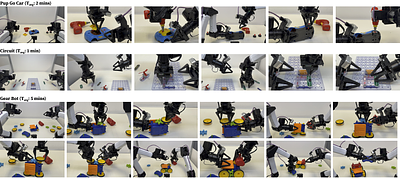
Recent robot foundation models operate with single-step or short-history visuomotor context. We introduce Test-Time-Training Robot Policies (RoboTTT), a robot model and training recipe that scale visuomotor context to 8K timesteps, three orders of magnitude beyond state-of-the-art policies, without growing inference latency. At this context length, we unlock new robot capabilities: one-shot in-context imitation from human video demonstrations, on-the-fly policy improvement, robustness to perturbations, and stronger performance on multi-stage, long-horizon tasks. We also observe, for the first time, steady gains in closed-loop performance as pretraining context length scales. At its core, RoboTTT integrates Test-Time Training into robot foundation models such as Vision-Language-Action policies, yielding a sequence model whose recurrent state consists of fast weights, parameters updated by gradient descent during both training and inference, compressing histories into weight space and retrieving contextual information for long-context conditioning. To scale training context length, the recipe combines sequence action forcing with truncated backpropagation through time. On challenging real-robot manipulation tasks, RoboTTT improves overall performance by 87% over the single-step context baseline and fully completes a five-minute, ten-stage assembly task, which no baseline ever does. RoboTTT trained with 8K-timestep context outperforms the same model pretrained with 1K timesteps by 62%, suggesting context length as a new scaling axis for robot foundation models. Videos are available at https://research.nvidia.com/labs/gear/robottt/ less
By: Yi Chen, Yuying Ge, Hui Zhou, Mingyu Ding, Yixiao Ge, Xihui Liu
The development of Vision-Language-Action (VLA) models has been significantly accelerated by pre-trained Vision-Language Models (VLMs). However, most existing end-to-end VLAs treat the VLM primarily as a multimodal encoder, directly mapping vision-language features to low-level actions. This paradigm underutilizes the VLM's potential in high-level decision making and introduces training instability, frequently degrading its rich semantic repr... more
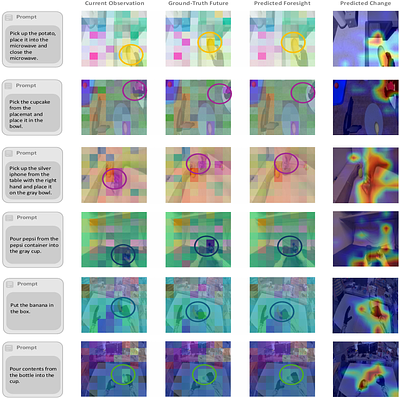
The development of Vision-Language-Action (VLA) models has been significantly accelerated by pre-trained Vision-Language Models (VLMs). However, most existing end-to-end VLAs treat the VLM primarily as a multimodal encoder, directly mapping vision-language features to low-level actions. This paradigm underutilizes the VLM's potential in high-level decision making and introduces training instability, frequently degrading its rich semantic representations. To address these limitations, we introduce DIAL, a framework bridging high-level decision making and low-level motor execution through a differentiable latent intent bottleneck. Specifically, a VLM-based System-2 performs latent world modeling by synthesizing latent visual foresight within the VLM's native feature space; this foresight explicitly encodes intent and serves as the structural bottleneck. A lightweight System-1 policy then decodes this predicted intent together with the current observation into precise robot actions via latent inverse dynamics. To ensure optimization stability, we employ a two-stage training paradigm: a decoupled warmup phase where System-2 learns to predict latent futures while System-1 learns motor control under ground-truth future guidance within a unified feature space, followed by seamless end-to-end joint optimization. This enables action-aware gradients to refine the VLM backbone in a controlled manner, preserving pre-trained knowledge. Extensive experiments on the RoboCasa GR1 Tabletop benchmark show that DIAL establishes a new state-of-the-art, achieving superior performance with 10x fewer demonstrations than prior methods. Furthermore, by leveraging heterogeneous human demonstrations, DIAL learns physically grounded manipulation priors and exhibits robust zero-shot generalization to unseen objects and novel configurations during real-world deployment on a humanoid robot. less
By: Zehao Wang, Huaide Jiang, Shuaiwu Dong, Yuping Wang, Hang Qiu, Jiachen Li
Human driving behavior is inherently personal, which is shaped by long-term habits and influenced by short-term intentions. Individuals differ in how they accelerate, brake, merge, yield, and overtake across diverse situations. However, existing end-to-end autonomous driving systems either optimize for generic objectives or rely on fixed driving modes, lacking the ability to adapt to individual preferences or interpret natural language intent... more
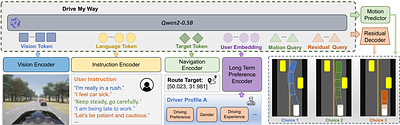
Human driving behavior is inherently personal, which is shaped by long-term habits and influenced by short-term intentions. Individuals differ in how they accelerate, brake, merge, yield, and overtake across diverse situations. However, existing end-to-end autonomous driving systems either optimize for generic objectives or rely on fixed driving modes, lacking the ability to adapt to individual preferences or interpret natural language intent. To address this gap, we propose Drive My Way (DMW), a personalized Vision-Language-Action (VLA) driving framework that aligns with users' long-term driving habits and adapts to real-time user instructions. DMW learns a user embedding from our personalized driving dataset collected across multiple real drivers and conditions the policy on this embedding during planning, while natural language instructions provide additional short-term guidance. Closed-loop evaluation on the Bench2Drive benchmark demonstrates that DMW improves style instruction adaptation, and user studies show that its generated behaviors are recognizable as each driver's own style, highlighting personalization as a key capability for human-centered autonomous driving. Our data and code are available at https://dmw-cvpr.github.io/. less
By: Yinhuai Wang, Qihan Zhao, Yuen Fui Lau, Runyi Yu, Hok Wai Tsui, Qifeng Chen, Jingbo Wang, Jiangmiao Pang, Ping Tan
Enabling humanoid robots to perform agile and adaptive interactive tasks has long been a core challenge in robotics. Current approaches are bottlenecked by either the scarcity of realistic interaction data or the need for meticulous, task-specific reward engineering, which limits their scalability. To narrow this gap, we present HumanX, a full-stack framework that compiles human video into generalizable, real-world interaction skills for huma... more
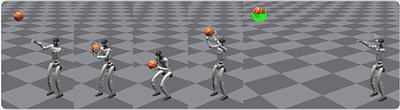
Enabling humanoid robots to perform agile and adaptive interactive tasks has long been a core challenge in robotics. Current approaches are bottlenecked by either the scarcity of realistic interaction data or the need for meticulous, task-specific reward engineering, which limits their scalability. To narrow this gap, we present HumanX, a full-stack framework that compiles human video into generalizable, real-world interaction skills for humanoids, without task-specific rewards. HumanX integrates two co-designed components: XGen, a data generation pipeline that synthesizes diverse and physically plausible robot interaction data from video while supporting scalable data augmentation; and XMimic, a unified imitation learning framework that learns generalizable interaction skills. Evaluated across five distinct domains--basketball, football, badminton, cargo pickup, and reactive fighting--HumanX successfully acquires 10 different skills and transfers them zero-shot to a physical Unitree G1 humanoid. The learned capabilities include complex maneuvers such as pump-fake turnaround fadeaway jumpshots without any external perception, as well as interactive tasks like sustained human-robot passing sequences over 10 consecutive cycles--learned from a single video demonstration. Our experiments show that HumanX achieves over 8 times higher generalization success than prior methods, demonstrating a scalable and task-agnostic pathway for learning versatile, real-world robot interactive skills. less

By: Wei Cao, Marcel Hallgarten, Tianyu Li, Daniel Dauner, Xunjiang Gu, Caojun Wang, Yakov Miron, Marco Aiello, Hongyang Li, Igor Gilitschenski, Boris Ivanovic, Marco Pavone, Andreas Geiger, Kashyap Chitta
Existing evaluation paradigms for Autonomous Vehicles (AVs) face critical limitations. Real-world evaluation is often challenging due to safety concerns and a lack of reproducibility, whereas closed-loop simulation can face insufficient realism or high computational costs. Open-loop evaluation, while being efficient and data-driven, relies on metrics that generally overlook compounding errors. In this paper, we propose pseudo-simulation, a no... more
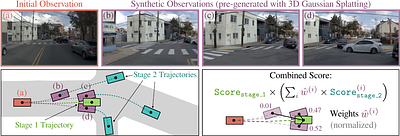
Existing evaluation paradigms for Autonomous Vehicles (AVs) face critical limitations. Real-world evaluation is often challenging due to safety concerns and a lack of reproducibility, whereas closed-loop simulation can face insufficient realism or high computational costs. Open-loop evaluation, while being efficient and data-driven, relies on metrics that generally overlook compounding errors. In this paper, we propose pseudo-simulation, a novel paradigm that addresses these limitations. Pseudo-simulation operates on real datasets, similar to open-loop evaluation, but augments them with synthetic observations generated prior to evaluation using 3D Gaussian Splatting. Our key idea is to approximate potential future states the AV might encounter by generating a diverse set of observations that vary in position, heading, and speed. Our method then assigns a higher importance to synthetic observations that best match the AV's likely behavior using a novel proximity-based weighting scheme. This enables evaluating error recovery and the mitigation of causal confusion, as in closed-loop benchmarks, without requiring sequential interactive simulation. We show that pseudo-simulation is better correlated with closed-loop simulations (R^2=0.8) than the best existing open-loop approach (R^2=0.7). We also establish a public leaderboard for the community to benchmark new methodologies with pseudo-simulation. Our code is available at https://github.com/autonomousvision/navsim. less

By: Zhao-Heng Yin, Sherry Yang, Pieter Abbeel
Learning robot control policies from human videos is a promising direction for scaling up robot learning. However, how to extract action knowledge (or action representations) from videos for policy learning remains a key challenge. Existing action representations such as video frames, pixelflow, and pointcloud flow have inherent limitations such as modeling complexity or loss of information. In this paper, we propose to use object-centric 3D ... more
Learning robot control policies from human videos is a promising direction for scaling up robot learning. However, how to extract action knowledge (or action representations) from videos for policy learning remains a key challenge. Existing action representations such as video frames, pixelflow, and pointcloud flow have inherent limitations such as modeling complexity or loss of information. In this paper, we propose to use object-centric 3D motion field to represent actions for robot learning from human videos, and present a novel framework for extracting this representation from videos for zero-shot control. We introduce two novel components in its implementation. First, a novel training pipeline for training a ''denoising'' 3D motion field estimator to extract fine object 3D motions from human videos with noisy depth robustly. Second, a dense object-centric 3D motion field prediction architecture that favors both cross-embodiment transfer and policy generalization to background. We evaluate the system in real world setups. Experiments show that our method reduces 3D motion estimation error by over 50% compared to the latest method, achieve 55% average success rate in diverse tasks where prior approaches fail~($\lesssim 10$\%), and can even acquire fine-grained manipulation skills like insertion. less

By: Xinrui Wang, Yan Jin
Reinforcement learning (RL) has demonstrated remarkable potential in robotic manipulation but faces challenges in sample inefficiency and lack of interpretability, limiting its applicability in real world scenarios. Enabling the agent to gain a deeper understanding and adapt more efficiently to diverse working scenarios is crucial, and strategic knowledge utilization is a key factor in this process. This paper proposes a Knowledge Capture, Ad... more
Reinforcement learning (RL) has demonstrated remarkable potential in robotic manipulation but faces challenges in sample inefficiency and lack of interpretability, limiting its applicability in real world scenarios. Enabling the agent to gain a deeper understanding and adapt more efficiently to diverse working scenarios is crucial, and strategic knowledge utilization is a key factor in this process. This paper proposes a Knowledge Capture, Adaptation, and Composition (KCAC) framework to systematically integrate knowledge transfer into RL through cross-task curriculum learning. KCAC is evaluated using a two block stacking task in the CausalWorld benchmark, a complex robotic manipulation environment. To our knowledge, existing RL approaches fail to solve this task effectively, reflecting deficiencies in knowledge capture. In this work, we redesign the benchmark reward function by removing rigid constraints and strict ordering, allowing the agent to maximize total rewards concurrently and enabling flexible task completion. Furthermore, we define two self-designed sub-tasks and implement a structured cross-task curriculum to facilitate efficient learning. As a result, our KCAC approach achieves a 40 percent reduction in training time while improving task success rates by 10 percent compared to traditional RL methods. Through extensive evaluation, we identify key curriculum design parameters subtask selection, transition timing, and learning rate that optimize learning efficiency and provide conceptual guidance for curriculum based RL frameworks. This work offers valuable insights into curriculum design in RL and robotic learning. less