By: Jian Liu, Xiongtao Shi, Thai Duy Nguyen, Haitian Zhang, Tianxiang Zhang, Wei Sun, Yanjie Li, Athanasios V. Vasilakos, Giovanni Iacca, Arshad Ali Khan, Arvind Kumar, Jae Won Cho, Ajmal Mian, Lihua Xie, Erik Cambria, Lin Wang
The rapid evolution of artificial intelligence (AI) has shifted from static, data-driven models to dynamic systems capable of perceiving and interacting with real-world environments. Despite advancements in pattern recognition and symbolic reasoning, current AI systems, such as large language models, remain disembodied, unable to physically engage with the world. This limitation has driven the rise of embodied AI, where autonomous agents, suc... more
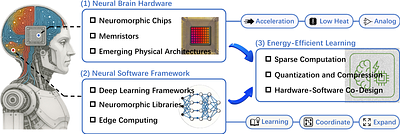
The rapid evolution of artificial intelligence (AI) has shifted from static, data-driven models to dynamic systems capable of perceiving and interacting with real-world environments. Despite advancements in pattern recognition and symbolic reasoning, current AI systems, such as large language models, remain disembodied, unable to physically engage with the world. This limitation has driven the rise of embodied AI, where autonomous agents, such as humanoid robots, must navigate and manipulate unstructured environments with human-like adaptability. At the core of this challenge lies the concept of Neural Brain, a central intelligence system designed to drive embodied agents with human-like adaptability. A Neural Brain must seamlessly integrate multimodal sensing and perception with cognitive capabilities. Achieving this also requires an adaptive memory system and energy-efficient hardware-software co-design, enabling real-time action in dynamic environments. This paper introduces a unified framework for the Neural Brain of embodied agents, addressing two fundamental challenges: (1) defining the core components of Neural Brain and (2) bridging the gap between static AI models and the dynamic adaptability required for real-world deployment. To this end, we propose a biologically inspired architecture that integrates multimodal active sensing, perception-cognition-action function, neuroplasticity-based memory storage and updating, and neuromorphic hardware/software optimization. Furthermore, we also review the latest research on embodied agents across these four aspects and analyze the gap between current AI systems and human intelligence. By synthesizing insights from neuroscience, we outline a roadmap towards the development of generalizable, autonomous agents capable of human-level intelligence in real-world scenarios. less

By: Tony Tao, Mohan Kumar Srirama, Jason Jingzhou Liu, Kenneth Shaw, Deepak Pathak
Large-scale, diverse robot datasets have emerged as a promising path toward enabling dexterous manipulation policies to generalize to novel environments, but acquiring such datasets presents many challenges. While teleoperation provides high-fidelity datasets, its high cost limits its scalability. Instead, what if people could use their own hands, just as they do in everyday life, to collect data? In DexWild, a diverse team of data collectors... more
Large-scale, diverse robot datasets have emerged as a promising path toward enabling dexterous manipulation policies to generalize to novel environments, but acquiring such datasets presents many challenges. While teleoperation provides high-fidelity datasets, its high cost limits its scalability. Instead, what if people could use their own hands, just as they do in everyday life, to collect data? In DexWild, a diverse team of data collectors uses their hands to collect hours of interactions across a multitude of environments and objects. To record this data, we create DexWild-System, a low-cost, mobile, and easy-to-use device. The DexWild learning framework co-trains on both human and robot demonstrations, leading to improved performance compared to training on each dataset individually. This combination results in robust robot policies capable of generalizing to novel environments, tasks, and embodiments with minimal additional robot-specific data. Experimental results demonstrate that DexWild significantly improves performance, achieving a 68.5% success rate in unseen environments-nearly four times higher than policies trained with robot data only-and offering 5.8x better cross-embodiment generalization. Video results, codebases, and instructions at https://dexwild.github.io less
By: Seungjae Lee, Daniel Ekpo, Haowen Liu, Furong Huang, Abhinav Shrivastava, Jia-Bin Huang
Exploration is essential for general-purpose robotic learning, especially in open-ended environments where dense rewards, explicit goals, or task-specific supervision are scarce. Vision-language models (VLMs), with their semantic reasoning over objects, spatial relations, and potential outcomes, present a compelling foundation for generating high-level exploratory behaviors. However, their outputs are often ungrounded, making it difficult to ... more
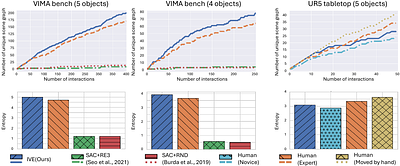
Exploration is essential for general-purpose robotic learning, especially in open-ended environments where dense rewards, explicit goals, or task-specific supervision are scarce. Vision-language models (VLMs), with their semantic reasoning over objects, spatial relations, and potential outcomes, present a compelling foundation for generating high-level exploratory behaviors. However, their outputs are often ungrounded, making it difficult to determine whether imagined transitions are physically feasible or informative. To bridge the gap between imagination and execution, we present IVE (Imagine, Verify, Execute), an agentic exploration framework inspired by human curiosity. Human exploration is often driven by the desire to discover novel scene configurations and to deepen understanding of the environment. Similarly, IVE leverages VLMs to abstract RGB-D observations into semantic scene graphs, imagine novel scenes, predict their physical plausibility, and generate executable skill sequences through action tools. We evaluate IVE in both simulated and real-world tabletop environments. The results show that IVE enables more diverse and meaningful exploration than RL baselines, as evidenced by a 4.1 to 7.8x increase in the entropy of visited states. Moreover, the collected experience supports downstream learning, producing policies that closely match or exceed the performance of those trained on human-collected demonstrations. less



4 SciCasts by Enrique Soriano-Salvador.