By: Yuyang Hua, Zhonghai Zhao, Bin Qiao
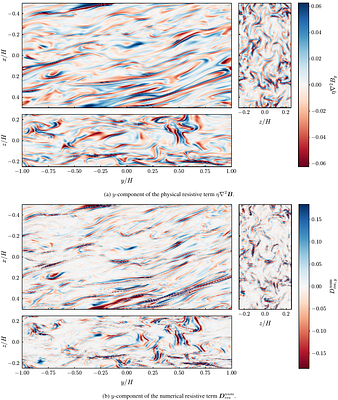
Comprehensive characterization of numerical dissipation is essential for high-fidelity simulations of magnetohydrodynamic (MHD) turbulence. In this work, we present an a posteriori framework for directly estimating numerical dissipation in MHD turbulence from simulation data without invoking a priori assumptions. Implemented in the open-source Python package PyMHD, the framework is applied to simulations of Alfvénic turbulence, turbulent smal... more
Comprehensive characterization of numerical dissipation is essential for high-fidelity simulations of magnetohydrodynamic (MHD) turbulence. In this work, we present an a posteriori framework for directly estimating numerical dissipation in MHD turbulence from simulation data without invoking a priori assumptions. Implemented in the open-source Python package PyMHD, the framework is applied to simulations of Alfvénic turbulence, turbulent small-scale dynamos, and MRI-driven turbulence, yielding a systematic characterization of the anisotropy and spectral properties of numerical dissipation across these regimes. The results indicate that numerical dissipation primarily dissipates energy transferred by the turbulent cascade at small scales, consistent with the conventional interpretation. However, its spectral properties are distinct from those of physical viscosity and resistivity, such that it cannot simply be represented by effective dissipation coefficients. In addition, numerical dissipation inherits the anisotropy of the underlying turbulence, and can even exhibit anomalous anti-dissipative behavior under certain circumstances. Moreover, this framework enables identification of the conditions under which physical dissipation dominates numerical dissipation across all scales, thereby providing practical guidance for achieving high-fidelity simulations of astrophysical MHD turbulence. less
By: Hubert Baty
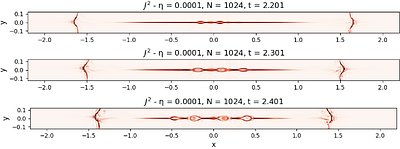
We investigate the conditions for triggering the plasmoid instability in a dynamically forming current sheet in the resistive magnetohydrodynamic framework, using a pseudo-spectral code applied to the Orszag-Tang vortex at Lundquist number $S \sim 10^5$. Following García Morillo \& Alexakis (2025), we use the power spectrum of the current density $E_J(k)$, complemented by the vorticity spectrum $E_ω(k)$, to assess the convergence of our simul... more
We investigate the conditions for triggering the plasmoid instability in a dynamically forming current sheet in the resistive magnetohydrodynamic framework, using a pseudo-spectral code applied to the Orszag-Tang vortex at Lundquist number $S \sim 10^5$. Following García Morillo \& Alexakis (2025), we use the power spectrum of the current density $E_J(k)$, complemented by the vorticity spectrum $E_ω(k)$, to assess the convergence of our simulations, and show that this diagnostic remains valid even in the presence of physical plasmoids, allowing us to unambiguously distinguish them from spurious ones. We then show that physical plasmoids can be triggered in a well-resolved spectral simulation when three conditions are simultaneously met: a perturbation applied near the time of maximum current density, with amplitude above a critical threshold $\varepsilon_c \sim 10^{-5}$ for our numerical scheme, and with spectral content containing the unstable wavenumbers. These conditions are confirmed using continuous noise injection, which yields similar results at amplitudes one to two orders of magnitude lower. The resulting growth rates and plasmoid numbers are in good agreement with the theory of \citet{Comisso2017}. These results resolve the apparent paradox raised by García Morillo \& Alexakis (2025) and also clarify the role of numerical noise in the triggering of the plasmoid instability. less
By: Francisco Ley, Aaron Tran, Ellen G. Zweibel
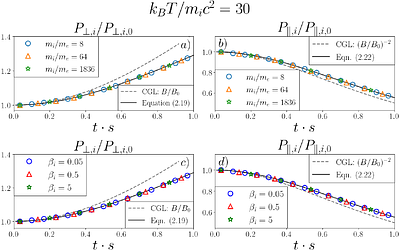
We revisit the double adiabatic evolution equations and extend them to the relativistic and ultrarelativistic regimes. We analytically solve the relativistic, time-dependent drift kinetic equation for a homogeneous, magnetized, collisionless plasma and obtain a solution explicitly dependent on the magnetic field and density variations. In the case of an initial relativistic Maxwellian distribution, a natural extension to an anisotropic Maxwel... more
We revisit the double adiabatic evolution equations and extend them to the relativistic and ultrarelativistic regimes. We analytically solve the relativistic, time-dependent drift kinetic equation for a homogeneous, magnetized, collisionless plasma and obtain a solution explicitly dependent on the magnetic field and density variations. In the case of an initial relativistic Maxwellian distribution, a natural extension to an anisotropic Maxwell-Jüttner is obtained. We calculate the moments of this time-dependent solution and obtain analytical expressions for the evolution of the perpendicular and parallel pressures in the ultrarelativistic case. We numerically solve the moment equations in the relativistic case and obtain general expressions for the double-adiabatic equations in this regime. We confirm our results using fully kinetic particle-in-cell simulations of shearing and compressing boxes. Our findings can be readily applied to relativistic species including cosmic-rays and electron-positron pairs, present in astrophysical plasmas like pulsar wind nebulae, astrophysical jets, black hole accretion flows, and Van Allen radiation belts. less