Proof-Carrying Materials: Falsifiable Safety Certificates for Machine-Learned Interatomic Potentials
0upvotes
By: Abhinaba Basu, Pavan Chakraborty
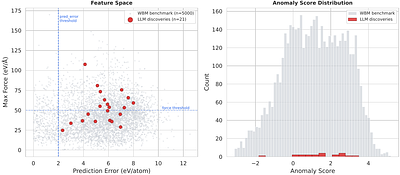
Machine-learned interatomic potentials (MLIPs) are deployed for high-throughput materials screening without formal reliability guarantees. We show that a single MLIP used as a stability filter misses 93% of density functional theory (DFT)-stable materials (recall 0.07) on a 25,000-material benchmark. Proof-Carrying Materials (PCM) closes this gap through three stages: adversarial falsification across compositional space, bootstrap envelope re... more
Machine-learned interatomic potentials (MLIPs) are deployed for high-throughput materials screening without formal reliability guarantees. We show that a single MLIP used as a stability filter misses 93% of density functional theory (DFT)-stable materials (recall 0.07) on a 25,000-material benchmark. Proof-Carrying Materials (PCM) closes this gap through three stages: adversarial falsification across compositional space, bootstrap envelope refinement with 95% confidence intervals, and Lean 4 formal certification. Auditing CHGNet, TensorNet and MACE reveals architecture-specific blind spots with near-zero pairwise error correlations (r <= 0.13; n = 5,000), confirmed by independent Quantum ESPRESSO validation (20/20 converged; median DFT/CHGNet force ratio 12x). A risk model trained on PCM-discovered features predicts failures on unseen materials (AUC-ROC = 0.938 +/- 0.004) and transfers across architectures (cross-MLIP AUC-ROC ~ 0.70; feature importance r = 0.877). In a thermoelectric screening case study, PCM-audited protocols discover 62 additional stable materials missed by single-MLIP screening - a 25% improvement in discovery yield. less
By: Hossein Hosseinabadi, Yaroslav Tserkovnyak, Eugene Demler, Jamir Marino
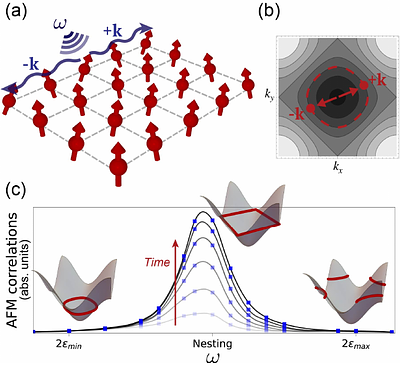
We uncover a new class of dynamical quantum instability in driven magnets leading to emergent enhancement of antiferromagnetic correlations even for purely ferromagnetic microscopic couplings. A primary parametric amplification creates a frequency-tuned nested magnon distribution in momentum space, which seeds a secondary instability marked by the emergence of enhanced antiferromagnetic correlations, mirroring Fermi surface nesting instabilit... more
We uncover a new class of dynamical quantum instability in driven magnets leading to emergent enhancement of antiferromagnetic correlations even for purely ferromagnetic microscopic couplings. A primary parametric amplification creates a frequency-tuned nested magnon distribution in momentum space, which seeds a secondary instability marked by the emergence of enhanced antiferromagnetic correlations, mirroring Fermi surface nesting instabilities in electronic systems. In sharp contrast to the fermionic case, however, the magnon-driven instability is intrinsically non-equilibrium and fundamentally inaccessible in thermal physics. Its quantum mechanical origin sets it apart from classical instabilities such as Faraday and modulation instabilities, which underlie several instances of dynamical behavior observed in magnetic and cold-atom systems. less




By: Andreas Sinner, Pierre A. Pantaleón, Francisco Guinea
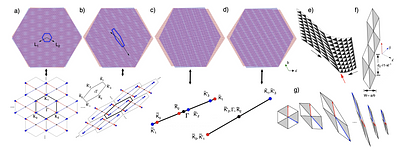
We study the effects of strain in moir\'e systems composed of honeycomb
lattices. We elucidate the formation of almost perfect one-dimensional moir\'e
patterns in twisted bilayer systems. The formation of such patterns is a
consequence of an interplay between twist and strain which gives rise to a
collapse of the reciprocal space unit cell. As a criterion for such collapse we
find a simple relation between the two quantities and the materia... more
We study the effects of strain in moir\'e systems composed of honeycomb
lattices. We elucidate the formation of almost perfect one-dimensional moir\'e
patterns in twisted bilayer systems. The formation of such patterns is a
consequence of an interplay between twist and strain which gives rise to a
collapse of the reciprocal space unit cell. As a criterion for such collapse we
find a simple relation between the two quantities and the material specific
Poisson ratio. The induced one dimensional behavior is characterized by two,
usually incommensurate, periodicities. Our results offer explanations for the
complex patterns of one-dimensional channels observed in low angle twisted
bilayer graphene systems and twisted bilayer dicalcogenides. Our findings can
be applied to any hexagonal twisted moir\'e pattern and can be easily extended
to other geometries.
less
By: Qiangqiang Gu, Shishir Kumar Pandey
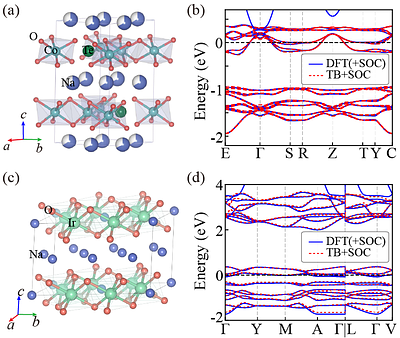
Spin-orbit coupling (SOC) drives interesting and non-trivial phenomena in
solid state physics, ranging from topological to magnetic to transport
properties. Thorough study of such phenomena often require effective models
where SOC term is explicitly included. However, estimation of SOC strength for
such models mostly depend on the spectroscopy experiments which can only
provide a rough estimate. In this work, we provide a simple yet effecti... more
Spin-orbit coupling (SOC) drives interesting and non-trivial phenomena in
solid state physics, ranging from topological to magnetic to transport
properties. Thorough study of such phenomena often require effective models
where SOC term is explicitly included. However, estimation of SOC strength for
such models mostly depend on the spectroscopy experiments which can only
provide a rough estimate. In this work, we provide a simple yet effective
computational approach to estimate the on-site SOC strength using a combination
of the $ab$ $initio$ and tight-binding calculations. We demonstrate the wider
applicability and high sensitivity of our method considering materials with
varying SOC strengths and the number of SOC active ions. The estimated SOC
strengths agree well with the proposed values in literature lending support to
our methodology. This simplistic approach can readily be applied to a wide
range of materials.
less