By: I. V Krasnov, N. S. Nedelko
The accumulation of observational data in recent years has led to a peculiar situation in which measurements of the cosmological parameters made by various collaborations and using different methods yield significantly different values. A solution to this problem may be found by modifying the models used to obtain these values. In this work, we revisit the standard approach to the recombination calculation and investigate a mechanism that can... more
The accumulation of observational data in recent years has led to a peculiar situation in which measurements of the cosmological parameters made by various collaborations and using different methods yield significantly different values. A solution to this problem may be found by modifying the models used to obtain these values. In this work, we revisit the standard approach to the recombination calculation and investigate a mechanism that can introduce corrections to the rate at which Lyman-alpha photons escape the resonance line. We find that interactions of Lyman-alpha line photons with moving neutral hydrogen atoms can become a source of such a correction. An analysis of CMB data for the modified model favors the existence of a non-Hubble redshift effect and prefers slightly higher values of $H_0$ and smaller values of $Ω_m$ and $S_8$ compared to the standard $Λ$CDM model, as well as a smaller value of the scalar spectrum index $n_s$. less
By: Koushik Dutta, Deep Ghosh, Ahamadullah Khan
Dark matter (DM), secluded from the Standard Model (SM), can attain internal thermalization through self-interactions. We investigate the thermalization of a real scalar DM field with a quartic self-coupling, initially produced from the perturbative decay of the coherently oscillating inflaton field during reheating. The thermalization process has been studied numerically by solving Boltzmann equation of the DM momentum distribution function ... more
Dark matter (DM), secluded from the Standard Model (SM), can attain internal thermalization through self-interactions. We investigate the thermalization of a real scalar DM field with a quartic self-coupling, initially produced from the perturbative decay of the coherently oscillating inflaton field during reheating. The thermalization process has been studied numerically by solving Boltzmann equation of the DM momentum distribution function in presence of $2\rightarrow2$ DM elastic self-scatterings. In the absence of number-changing processes, the thermalized dark sector is characterized by a temperature and a nonzero chemical potential, determined by the inflaton mass and the reheat temperature. We find that if the inflaton mass is greater (smaller) than the reheat temperature, the DM temperature can be greater (smaller) than the SM temperature during Big Bang Nucleosynthesis, without violating any cosmological constraints. This is realized with a negative (positive) chemical potential for the DM temperature greater (smaller) than the SM one. Depending on DM production history, we can achieve the lower limit on the DM mass much below than in warm DM scenarios. The thermalization via self-scatterings tends to suppress the DM co-moving free-streaming length, compared to the non-thermal scenario without any collisions. Consequently, the lower limit on the DM mass weakens approximately by $40\%$ for a suitable choice of quartic self-coupling than in the non-thermal scenario. We obtain the lower limits on the thermal DM mass to be $2.2\times10^{-10}$ GeV and $0.47$ GeV for reheat temperatures, $5\times 10^6$ GeV and $5$ MeV respectively, while the inflaton mass is set at $10^3$ GeV. less
By: Shao-Feng Ge, Sk Jeesun, Tao Li
This work explores the production of an MeV-scale electrophilic axion-like particles (ALPs) by utilizing the monochromatic 5.5MeV photon resulting from the nuclear fusion processes in the Sun. These 5.5MeV photons can undergo the Compton-like scattering with the ambient electrons in the solar matter to produce a substantial flux of MeV ALPs. Upon reaching the Earth, such ALPs can be detected via the same electron coupling, offering a new oppo... more
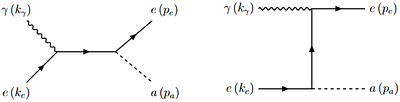
This work explores the production of an MeV-scale electrophilic axion-like particles (ALPs) by utilizing the monochromatic 5.5MeV photon resulting from the nuclear fusion processes in the Sun. These 5.5MeV photons can undergo the Compton-like scattering with the ambient electrons in the solar matter to produce a substantial flux of MeV ALPs. Upon reaching the Earth, such ALPs can be detected via the same electron coupling, offering a new opportunity for the dark matter (DM) direct detection experiments to probe the previously unexplored parameter regions. We show that the existing data of LZ, PandaX-4T, and Borexino can attain the sensitivities $g_{ae} \lesssim 3.7 \times 10^{-6}$, $g_{ae} \lesssim 3.7 \times 10^{-6}$ and $g_{ae} \lesssim 1.7 \times 10^{-6}$, respectively, for $m_a \lesssim 1$MeV. An optimistic 200 tonne$\times$year exposure by PandaX-xT can reach $g_{ae}\lesssim 1.6 \times 10^{-6}$ for most of the mass window $m_a < 1$MeV and even $g_{ae} \lesssim 1.5 \times 10^{-7}$ with $m_a$ approaching 1MeV. Despite the stringent constraints from different laboratory experiments and astrophysical observations, our obtained limits from LZ, PandaX-4T, and Borexino can probe new parameter regions, specifically in the mass window $0.4\,{\rm MeV} \lesssim m_a \lesssim 1$MeV. less
By: Anish Ghoshal, Pratyay Pal, Alessandro Strumia
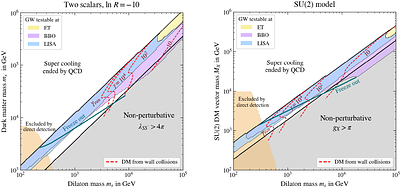
Collisions of ultra-relativistic bubbles during cosmological phase transitions can produce particles much heavier than the transition scale. Previous analyses modelled this process as the off-shell decay of the scalar background. We show that its results parametrically overestimate hard particle production and depend on the gauge choice and the coordinate choice in field space. We propose an alternative formalism, analogous to the partonic de... more
Collisions of ultra-relativistic bubbles during cosmological phase transitions can produce particles much heavier than the transition scale. Previous analyses modelled this process as the off-shell decay of the scalar background. We show that its results parametrically overestimate hard particle production and depend on the gauge choice and the coordinate choice in field space. We propose an alternative formalism, analogous to the partonic description of high-energy collisions. In the ultra-relativistic limit, the colliding bubbles undergo nearly free passage and hard production arises from on-shell scatterings among the quanta constituting the Lorentz-contracted walls. We apply this approach to heavy scalar, fermion, and vector particle production, and study the implications for dark matter, leptogenesis, graviton production and primordial gravitational waves. less
By: Marcos A. G. Garcia, Stephen E. Henrich, Wenqi Ke, Keith A. Olive
We study leptogenesis during non-instantaneous reheating in the canonical type-I seesaw framework, with the dominant source of right-handed neutrino (RHN) production being non-thermal from inflaton decays ($φ\rightarrow NN$). While matter-like reheating ($w_φ=0$) fails to be compatible with standard leptogenesis for very low reheating temperatures, the situation is strikingly different for generalized Starobinsky potentials approximated by $V... more
We study leptogenesis during non-instantaneous reheating in the canonical type-I seesaw framework, with the dominant source of right-handed neutrino (RHN) production being non-thermal from inflaton decays ($φ\rightarrow NN$). While matter-like reheating ($w_φ=0$) fails to be compatible with standard leptogenesis for very low reheating temperatures, the situation is strikingly different for generalized Starobinsky potentials approximated by $V(φ)\proptoφ^k$ with $k\geq4$ about the minimum. In the latter cases, the observed baryon asymmetry can readily be obtained for arbitrarily low reheating temperatures above the BBN bound of $\sim4$ MeV. We study radiation-like reheating ($w_φ=1/3$, $k=4$) in detail, showing that the evolving effective mass of the inflaton condensate leads to kinematic shutoff of the $φ\rightarrow NN$ channel, which qualitatively changes the leptogenesis dynamics. We include a detailed treatment of the effects of fragmentation of the inflaton condensate. The final baryon asymmetry depends primarily on only two parameters: the inflaton-RHN coupling, $y_{φNN}$, and the CP-violating parameter $|ε|$. Interestingly, the final asymmetry is largely insensitive to the RHN mass, the reheating temperature, and the RHN decay rate. While we focus on fermionic reheating, we show that the general features of these results also hold for bosonic reheating to scalars. less
By: Run-Min Yao, Xiao-Jun Bi, Peng-Fei Yin, Qing-Guo Huang
We develop a Floquet--Bloch sideband formulation of the linearized Maxwell--axion system in a coherent periodic axion background. Linearizing around prescribed magnetic and axion fields, we show that the pump generates a sideband ladder of photon and axion branches. Near an isolated folded degeneracy, this ladder reduces to a two-mode crossing whose algebra is fixed by the symplectic signatures of the colliding modes. In temporal fixed-moment... more
We develop a Floquet--Bloch sideband formulation of the linearized Maxwell--axion system in a coherent periodic axion background. Linearizing around prescribed magnetic and axion fields, we show that the pump generates a sideband ladder of photon and axion branches. Near an isolated folded degeneracy, this ladder reduces to a two-mode crossing whose algebra is fixed by the symplectic signatures of the colliding modes. In temporal fixed-momentum evolution, same-Krein-sign collisions give stable avoided crossings, whereas opposite-sign collisions give parametric instabilities, unifying the axion-photon difference channel with the Mathieu and Masaki-Aoki-Soda resonances. In stationary fixed-frequency transfer, the corresponding flux signatures distinguish bounded forward conversion from forward-backward stop bands and distributed reflection. Ray projection of a temporal pump gives a related but local WKB description of driven forward mixing, with an effective wavenumber distinct from the true axion momentum. External-field diagrams reproduce the sideband selection rules, and full temporal monodromy calculations verify the instability topology and finite-coupling shifts. less
By: Ruben Zatini, Jorge Martin Camalich, Pasquale Dario Serpico, Tobias Fischer
Strange hadrons are commonly included in dense-matter equation-of-state models by imposing chemical equilibrium, but the weak-interaction timescales required to establish it in core-collapse supernovae have not been systematically assessed. In this paper we compute the $Λ$-hyperon production rates in the hot, dense, and isospin-asymmetric conditions characteristic of post-collapse proto-neutron stars. We find that local $Λ$ chemical equilibra... more
Strange hadrons are commonly included in dense-matter equation-of-state models by imposing chemical equilibrium, but the weak-interaction timescales required to establish it in core-collapse supernovae have not been systematically assessed. In this paper we compute the $Λ$-hyperon production rates in the hot, dense, and isospin-asymmetric conditions characteristic of post-collapse proto-neutron stars. We find that local $Λ$ chemical equilibration is driven by nonleptonic strangeness-changing reactions, especially $NN\leftrightarrow NΛ$ scattering, on timescales of order $10^{-11}$-$10^{-10}$ s, many orders of magnitude shorter than macroscopic proto-neutron-star evolution timescales. Using an effective-field-theory framework constrained by hypernuclear weak-decay data, we find that short-range contact interactions dominate the nonleptonic rates, beyond a pure one-meson-exchange description. Semileptonic channels are too slow to set the equilibrium $Λ$ abundance, but they open additional absorption channels for low-energy muon neutrinos and antineutrinos, such as $ν_μ+Λ\toμ^-+p$ and $p+μ^-+\barν_μ\toΛ$. At low energies, these $Λ$-induced neutrino opacities exceed the corresponding nucleonic contributions for muon (anti)neutrinos, possibly influencing the evolution of the muon lepton number during proto-neutron-star deleptonization. These results support local chemical equilibrium for $Λ$ hyperons under the conditions studied and provide new weak-interaction input for flavor-dependent neutrino transport, muonization, and proto-neutron-star evolution. less
By: Stephan A. Meighen-Berger, R. Andrew Gustafson, Nicole F. Bell, Jayden L. Newstead, Sandra Robles, Ian M. Shoemaker
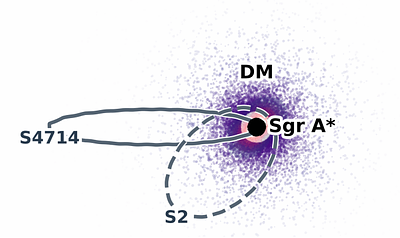
Stars on tight orbits around the supermassive black hole at the Galactic Center pass through regions where the dark matter~(DM) density may be strongly enhanced. We compute the orbit-averaged DM-induced energy exchange for S4714 as an example. It is a star on an exceptionally close and relativistic orbit around Sagittarius~A*. For a spiked dark matter profile, the exchange reaches the stellar luminosity at $σ_{χp} \sim 10^{-36}~\mathrm{cm}^2$... more
Stars on tight orbits around the supermassive black hole at the Galactic Center pass through regions where the dark matter~(DM) density may be strongly enhanced. We compute the orbit-averaged DM-induced energy exchange for S4714 as an example. It is a star on an exceptionally close and relativistic orbit around Sagittarius~A*. For a spiked dark matter profile, the exchange reaches the stellar luminosity at $σ_{χp} \sim 10^{-36}~\mathrm{cm}^2$ for MeV-GeV masses and $σ_{χe} \sim 5\times10^{-38}~\mathrm{cm}^2$ for sub-MeV masses, opening a new annihilation-free route toward dark-star phases. These cross sections lie within the range predicted by freeze-in scenarios and are consistent with cosmic-ray--boosted and solar-reflection dark matter constraints. less
By: Diogo S. Gorgulho, Jacob A. Litterer, João G. Rosa
We study the effects of string axion emission on dark matter production by light primordial black holes (PBHs), through both evaporation and superradiance. We show, in particular, that the Hawking emission of $\mathcal{O}(100-10^5)$ light axion species predicted in realistic string theory constructions can significantly enhance the efficiency of superradiance, given the associated increase in the PBH spin. The string axiverse thus significant... more
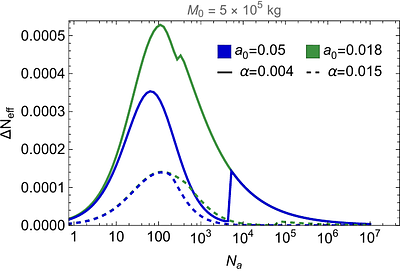
We study the effects of string axion emission on dark matter production by light primordial black holes (PBHs), through both evaporation and superradiance. We show, in particular, that the Hawking emission of $\mathcal{O}(100-10^5)$ light axion species predicted in realistic string theory constructions can significantly enhance the efficiency of superradiance, given the associated increase in the PBH spin. The string axiverse thus significantly expands the parametric regions (dark matter mass and PBH mass and spin) for which a sizeable fraction of dark matter may presently be in the form of ``micro-boson stars'': the self-gravitating remnants of superradiant dark matter clouds. Conversely, for too large a number of axion species PBHs evaporate too quickly for superradiant clouds to attain their maximum mass. Finally, assuming that all dark matter is produced by PBHs (through both superradiance and Hawking emission), we show that the axions emitted during PBH evaporation give an immeasurably small contribution to the relativistic degrees of freedom at recombination. less