The temporal distribution of SN1987A neutrino events

The temporal distribution of SN1987A neutrino events
Riccardo Maria Bozza, Vigilante di Risi, Veronica Oliviero, Giulia Ricciardi, Francesco Vissani
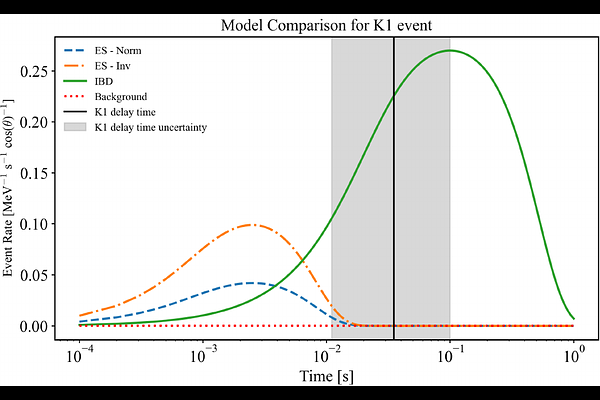
AbstractThe interpretation of the SN1987A neutrino data continues to be hindered by significant absolute timing uncertainties and a well-known tension in the angular distributions. We perform a quantitative, high-precision alignment of the Kamiokande-II and Baksan data with the IMB clock, using for the first time the relative time offset (RTO) and reducing the temporal uncertainty by two orders of magnitude to the sub-second level. The chi-square analysis shows that Baksan's absolute timestamps require an advancement of 30.4 s, while those of Kamiokande-II require a delay of about 6.4 s. The knowledge of the unified timeline provides a necessary and rigorous basis for testing whether the first Kamiokande-II event arose from the neutronization burst - a possibility motivated by its angular properties. Our analysis favors an accretion phase electron anti-neutrino origin over a neutronization-burst origin, with a likelihood ratio of 3-6, depending on the specific MSW oscillation scenario. This result corroborates the standard interpretation - that only inverse beta decay events were detected. Our framework yields the most stringent constraints to date on the SN1987A chronology and establishes a precision benchmark for future Galactic supernova observations.