By: Sounak Biswas, Sthitadhi Roy, Roderich Moessner
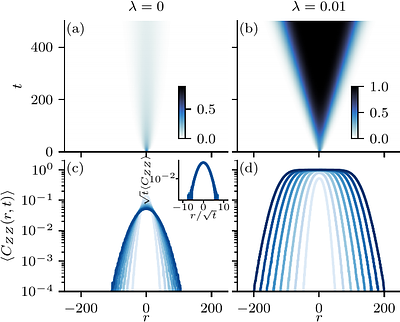
We develop a quantitative theory for the emergence of quantum many-body chaos as integrability is broken via a tunable parameter. In a circuit model of free fermions, 'doped' with a tunable density of integrability-breaking gates, we uncover the microscopic mechanisms underpinning the crossover from early-time integrable behaviour to late-time chaos through the lens of the out-of-time-ordered correlators (OTOCs). The integrability-breaking ga... more
We develop a quantitative theory for the emergence of quantum many-body chaos as integrability is broken via a tunable parameter. In a circuit model of free fermions, 'doped' with a tunable density of integrability-breaking gates, we uncover the microscopic mechanisms underpinning the crossover from early-time integrable behaviour to late-time chaos through the lens of the out-of-time-ordered correlators (OTOCs). The integrability-breaking gates act as local, in spacetime, hotspots which locally amplify the OTOCs such that an accumulation of them eventually leads to fully-developed chaos. We identify the explicit characteristic time and length scales governing this crossover, as well as the dependence of the chaotic OTOC characteristics -- such as the butterfly velocity and front broadening -- on the integrability-breaking parameter. less
By: Katja Klobas
The dynamics of local subsystems in a thermodynamically large quantum many-body system can be understood as effectively open as the system produces its own effective bath. The action of this bath can be characterised in terms of the so-called influence matrices. In generic situations, the complexity of these objects grows unfavourably with time, however, there exist solvable cases where influence matrices can be characterised exactly even in ... more
The dynamics of local subsystems in a thermodynamically large quantum many-body system can be understood as effectively open as the system produces its own effective bath. The action of this bath can be characterised in terms of the so-called influence matrices. In generic situations, the complexity of these objects grows unfavourably with time, however, there exist solvable cases where influence matrices can be characterised exactly even in the presence of non-trivial interactions. Here we show that Rule 201, a deterministic version of the Floquet-PXP model, is one of these solvable instances. Indeed, it admits influence matrices given by a finite-dimensional matrix-product operator (MPO) that solves a finite set of algebraic conditions. We provide the solution, and characterise multi-time autocorrelation functions. less
By: Sindre Brattegard, Stephanie Matern, Mark T. Mitchison, Saulo V. Moreira
In realistic nanoscale transport set-ups, electron-phonon coupling leads to the exchange of heat between phonon baths and electronic reservoirs with finite heat capacities. Such exchange affects the finite reservoir's temperature. However, this sensitivity of the finite reservoir temperature to the exchange of heat with the finite reservoir has remained unexplored for thermometry. Here, we fill this gap by combining current metrology techniqu... more
In realistic nanoscale transport set-ups, electron-phonon coupling leads to the exchange of heat between phonon baths and electronic reservoirs with finite heat capacities. Such exchange affects the finite reservoir's temperature. However, this sensitivity of the finite reservoir temperature to the exchange of heat with the finite reservoir has remained unexplored for thermometry. Here, we fill this gap by combining current metrology techniques with a thermodynamic framework encompassing finite reservoirs. We focus on an experimentally realizable set-up with a quantum dot coupled to a finite reservoir and consider two distinct current-based strategies in the long time limit, namely monitoring quanta exchanged between the quantum dot and finite reservoir and the measurement of the total current flowing from the quantum dot into an infinite reservoir. A third strategy involves measurements of the quantum dot occupation. For a large but finite reservoir, we show that the Fisher information for all three strategies captures the finite reservoir's contribution to sensitivity through common factors. We also demonstrate that monitoring quanta exchanged between the system and finite reservoir in the long time limit achieves optimal precision. Finally, we provide an optimization analysis that explores how maximal precision can be achieved within each of the current-based strategies by tuning the gate voltage. less



Nonequilibrium heat relation
0upvotes


By: Michael Winer, Christopher L. Baldwin, Richard Barney, Victor Galitski, Brian Swingle
We study the equilibrium thermodynamics of quantum hard spheres in the
infinite-dimensional limit, determining the boundary between liquid and glass
phases in the temperature-density plane by means of the Franz-Parisi potential.
We find that as the temperature decreases from high values, the effective
radius of the spheres is enhanced by a multiple of the thermal de Broglie
wavelength, thus increasing the effective filling fraction and decr... more
We study the equilibrium thermodynamics of quantum hard spheres in the
infinite-dimensional limit, determining the boundary between liquid and glass
phases in the temperature-density plane by means of the Franz-Parisi potential.
We find that as the temperature decreases from high values, the effective
radius of the spheres is enhanced by a multiple of the thermal de Broglie
wavelength, thus increasing the effective filling fraction and decreasing the
critical density for the glass phase. Numerical calculations show that the
critical density continues to decrease monotonically as the temperature
decreases further, suggesting that the system will form a glass at sufficiently
low temperatures for any density.
less

By: Victor Gurarie
Logarithmic operators and logarithmic conformal field theories are reviewed.
Prominent examples considered here include c=-2 and c=0 logarithmic conformal
field theories. c=0 logarithmic conformal field theories are especially
interesting since they describe some of the critical points of a variety of
longstanding problems involving a two dimensional quantum particle moving in a
spatially random potential, as well as critical two dimensiona... more
Logarithmic operators and logarithmic conformal field theories are reviewed.
Prominent examples considered here include c=-2 and c=0 logarithmic conformal
field theories. c=0 logarithmic conformal field theories are especially
interesting since they describe some of the critical points of a variety of
longstanding problems involving a two dimensional quantum particle moving in a
spatially random potential, as well as critical two dimensional self avoiding
random walks and percolation. Lack of classification of logarithmic conformal
field theories remains a major impediment to progress towards finding complete
solutions to these problems.
less
By: Sam Wilken, Ashley Z. Guo, Dov Levine, Paul M. Chaikin
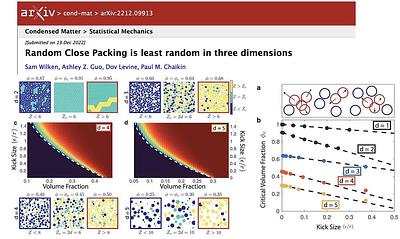
A simple dynamical model, Biased Random Organization, BRO, appears to produce the ensemble of configurations known as Random Close Packed (RCP) as its critical endpoint in dimension d=3. We conjecture that BRO likewise produces RCP in any dimension and come to the following conclusions: there is no RCP in
d=1 or d=2 (where dynamics lead to crystalline order); in d=3, d=4, and d=5, we recover RCP behavior with previously estimated packing fr... more
A simple dynamical model, Biased Random Organization, BRO, appears to produce the ensemble of configurations known as Random Close Packed (RCP) as its critical endpoint in dimension d=3. We conjecture that BRO likewise produces RCP in any dimension and come to the following conclusions: there is no RCP in
d=1 or d=2 (where dynamics lead to crystalline order); in d=3, d=4, and d=5, we recover RCP behavior with previously estimated packing fractions 0.64, 0.45, and 0.30 respectively, and the systems are isostatic with average contact numbers 6, 8, and 10. BRO belongs to the Manna universality class of dynamical phase transitions, which has well-defined critical exponents and an upper critical dimension of 4. Exponents are mean field for $4 \le d \le \infty$, which we confirm in simulations. Further, a hyperscaling relation between the correlation function exponent and density fluctuations implies that when mean field exponents hold, density fluctuations are random and not hyperuniform. Hence, hyperuniformity in RCP is only observed in d=3.
less