Universal Speed Limit in a Far-from-Equilibrium Bose Gas: Symmetry and Dynamical Decoherence
0upvotes
By: Jun-Cheng Liang, Bo Chen
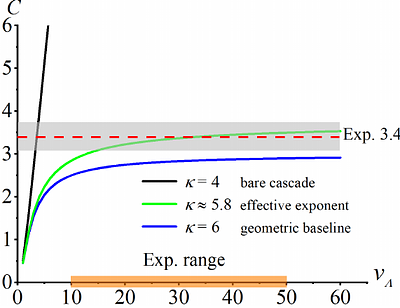
Predicting universal transport coefficients in far-from-equilibrium quantum systems remains a fundamental challenge. A paradigmatic example is the non-thermal fixed point (NTFP) of isolated Bose gases, where coherence spreads as $\ell^2(t) = C\hbar t/m$ with a universal constant $C$. While the scaling exponent $z=2$ is well established, the amplitude $C$ has remained elusive because the underlying particle cascade $n(k)\sim k^{-4}$ leads to a... more
Predicting universal transport coefficients in far-from-equilibrium quantum systems remains a fundamental challenge. A paradigmatic example is the non-thermal fixed point (NTFP) of isolated Bose gases, where coherence spreads as $\ell^2(t) = C\hbar t/m$ with a universal constant $C$. While the scaling exponent $z=2$ is well established, the amplitude $C$ has remained elusive because the underlying particle cascade $n(k)\sim k^{-4}$ leads to a divergent kinetic energy, threatening the very existence of a constant speed limit. Here we resolve this paradox and present the first analytical, parameter-free prediction of a universal amplitude $C$. A deep interplay between symmetry and dissipation is uncovered. The emergent weak U(1) symmetry at the NTFP enforces a conserved total current, forcing the low-energy phase dynamics to obey a diffusive Langevin equation with noise entering as the divergence of a stochastic current. This structure, combined with dynamical decoherence of high-momentum modes, yields a universal power-law momentum distribution $\tilde{f}(v)\sim(1+v^2)^{-3}$ (with $v=k\ell$) that naturally regularizes the ultraviolet divergence. From this, a parameter-free geometric baseline $C=3$ is obtained, independent of microscopic details. The experimental value $C=3.4(3)$ [Martirosyan et al., Nature 647, 608 (2025)] is then shown to be quantitatively consistent with universal logarithmic corrections arising from a marginally irrelevant coupling at the fixed point. A new paradigm is thus established for predicting transport coefficients in strongly correlated non-equilibrium systems: symmetry constraints determine the low-energy effective theory, dynamical decoherence provides a natural ultraviolet completion, and scaling analysis delivers testable predictions moving beyond scaling exponents to quantitative amplitude prediction. less
5 SciCasts by .

By: Thomas Kohlert, Sebastian Scherg, Pablo Sala, Frank Pollmann, Bharath Hebbe Madhusudhana, Immanuel Bloch, Monika Aidelsburger
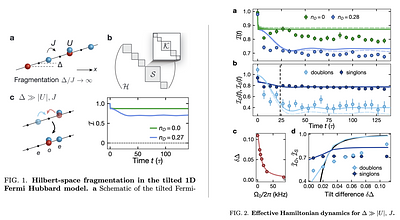
Quantum many-body systems may defy thermalization even without disorder.
Intriguingly, non-ergodicity may be caused by a fragmentation of the many-body
Hilbert-space into dynamically disconnected subspaces. The tilted
one-dimensional Fermi-Hubbard model was proposed as a platform to realize
fragmented models perturbatively in the limit of large tilt. Here, we
demonstrate the validity of this effective description for the transient
dynamics ... more
Quantum many-body systems may defy thermalization even without disorder.
Intriguingly, non-ergodicity may be caused by a fragmentation of the many-body
Hilbert-space into dynamically disconnected subspaces. The tilted
one-dimensional Fermi-Hubbard model was proposed as a platform to realize
fragmented models perturbatively in the limit of large tilt. Here, we
demonstrate the validity of this effective description for the transient
dynamics using ultracold fermions. The effective analytic model allows for a
detailed understanding of the emergent microscopic processes, which in our case
exhibit a pronounced doublon-number dependence. We study this experimentally by
tuning the doublon fraction in the initial state.
less
By: Milan Kornjača, Rhine Samajdar, Tommaso Macrì, Nathan Gemelke, Sheng-Tao Wang, Fangli Liu
Quantum spin liquids are elusive but paradigmatic examples of strongly
correlated quantum states that are characterized by long-range quantum
entanglement. Recently, the direct signatures of a gapped topological
$\mathbb{Z}_2$ spin liquid have been observed in a system of Rydberg atoms
arrayed on the ruby lattice. Here, we illustrate the concrete realization of a
fundamentally different class of spin liquids in a honeycomb array of Rydberg
... more
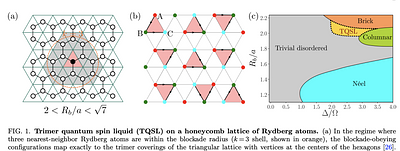
Quantum spin liquids are elusive but paradigmatic examples of strongly
correlated quantum states that are characterized by long-range quantum
entanglement. Recently, the direct signatures of a gapped topological
$\mathbb{Z}_2$ spin liquid have been observed in a system of Rydberg atoms
arrayed on the ruby lattice. Here, we illustrate the concrete realization of a
fundamentally different class of spin liquids in a honeycomb array of Rydberg
atoms. Exploring the quantum phase diagram of this system using both
density-matrix renormalization group and exact diagonalization simulations,
several density-wave-ordered phases are characterized and their origins
explained. More interestingly, in the regime where third-nearest-neighbor atoms
lie within the Rydberg blockade radius, we find a novel ground state -- with an
emergent $\mathrm{U}(1)\times \mathrm{U}(1)$ local symmetry -- formed from
superpositions of classical {\it trimer} configurations on the dual triangular
lattice. The fidelity of this trimer spin liquid state can be enhanced via
dynamical preparation, which we explain by a Rydberg-blockade-based projection
mechanism associated with the smooth turnoff of the laser drive. Finally, we
discuss the robustness of the trimer spin liquid phase under realistic
experimental parameters and demonstrate that our proposal can be readily
implemented in current Rydberg atom quantum simulators.
less