By: Hyunsoo Choi, Hyoung Won Baac, Zubin Jacob, Haejun Chung
Detecting terrestrial exoplanets in the habitable zones of nearby stars remains a critical challenge. Such planets can be \(10^8\) to \(10^{10}\) times fainter than their host stars and lie at diffraction-limited angular separations, where starlight strongly obscures the companion signal. Here we present an adaptive quantum measurement method for estimating the number, positions, and brightnesses of mutually incoherent point sources in the su... more
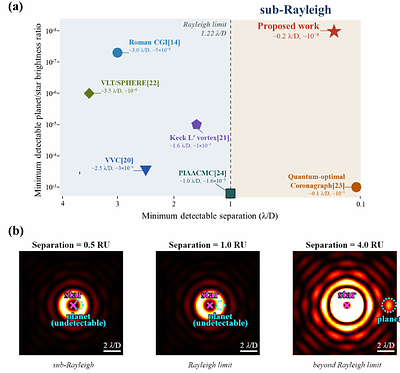
Detecting terrestrial exoplanets in the habitable zones of nearby stars remains a critical challenge. Such planets can be \(10^8\) to \(10^{10}\) times fainter than their host stars and lie at diffraction-limited angular separations, where starlight strongly obscures the companion signal. Here we present an adaptive quantum measurement method for estimating the number, positions, and brightnesses of mutually incoherent point sources in the sub-Rayleigh, ultra-high-contrast regime, operating at contrasts down to \(10^{-8}\) -- five orders of magnitude beyond previous quantum imaging approaches to exoplanet detection. The method adopts a spatial-mode basis that is updated to maximize the quantum Fisher information per detected photon. Estimation is performed by maximum likelihood in log-brightness coordinates, and the source count is determined by Bayesian-information-criterion (BIC) model selection directly from photon-count statistics, without a tunable detection threshold. For point sources within sub-Rayleigh separations and with brightness ratios spanning eight orders of magnitude, the method reconstructs complete scenes with a mean success rate of \(72.5\%\). Furthermore, it is robust to misalignment, maintaining a \(71.3\%\) success rate under offsets of up to six pixels. These results demonstrate that terrestrial exoplanets can be detected below the Rayleigh limit, a regime previously inaccessible to direct imaging. less
By: Parth Hemant Darekar, Amit Kumar Jha, Michael R. Grace, Aqil Sajjad, Saikat Guha
We consider the task of distinguishing between a single weak incoherent optical point source and two weak incoherent optical point sources located symmetrically about the first source. $θ$ is the separation between the two point sources scaled to the Point Spread Function (PSF) width in the image plane. Using an ideal focal plane array of intensity detectors (ideal direct imaging), we quantify the performance using the Bhattacharyya distance ... more
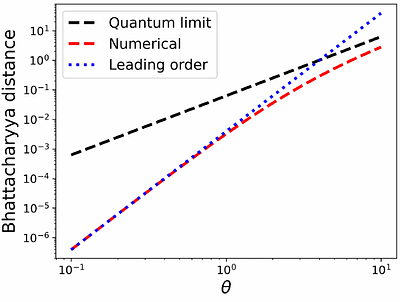
We consider the task of distinguishing between a single weak incoherent optical point source and two weak incoherent optical point sources located symmetrically about the first source. $θ$ is the separation between the two point sources scaled to the Point Spread Function (PSF) width in the image plane. Using an ideal focal plane array of intensity detectors (ideal direct imaging), we quantify the performance using the Bhattacharyya distance and find the scaling of its leading order term in terms of $θ$ in the sub-Rayleigh regime. A suite of previous analyses of this problem lacked a comprehensive analysis for when the amplitude spread function (ASF) of the imaging system has zeros and reported a scaling that we find to be incorrect. We complete this analysis by explicitly calculating the leading order term of the Bhattacharyya distance for ideal direct imaging with any ASF, for small $θ$ and show the difference in scaling based on the presence or absence of zeros in the ASF. This is similar to the ASF dependent performance in the task of estimating the separation between the two point sources and the task of detecting a change to an object. We then apply our results to the specific example of a Gaussian and a Sinc ASF and show good agreement with numerical calculations. Our results allow the accurate comparison of other measurement schemes with ideal direct imaging, and to the quantum limit. less
By: Sonali Gupta, Kiran Bajar, Alexander McFarland, Amit Kumar, Subhas Manna, Sushil Mujumdar
Optical imaging of quantum emitters is essential for a wide range of quantum applications. Conventional confocal imaging relies on point-by-point raster scanning, which is inherently time-consuming and photon-inefficient, particularly for sparse emitter distributions and photon-limited samples. Here, we demonstrate a compressive sensing-based imaging approach, where spatially structured wide-field excitation replaces raster scanning, enabling... more
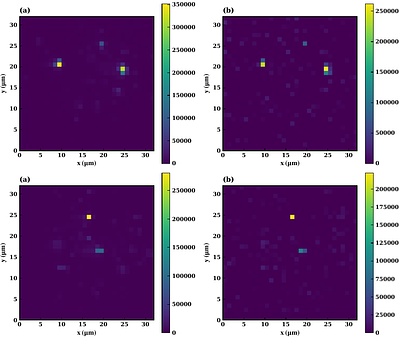
Optical imaging of quantum emitters is essential for a wide range of quantum applications. Conventional confocal imaging relies on point-by-point raster scanning, which is inherently time-consuming and photon-inefficient, particularly for sparse emitter distributions and photon-limited samples. Here, we demonstrate a compressive sensing-based imaging approach, where spatially structured wide-field excitation replaces raster scanning, enabling reconstruction of sparse emitters. In our implementation, random binary patterns are used to acquire compressive measurements, from which the spatial fluorescence distribution is reconstructed using a GPSR-BB algorithm. We experimentally demonstrate this approach using nitrogen-vacancy (NV) centers in diamond as a representative platform, with high-fidelity image reconstruction achieved using only approximately $20\%$ of the measurements required for conventional raster scanning. In addition to intensity reconstruction, we extend this framework to reconstruct spatial maps of the second-order correlation function $g^{(2)}(0)$ from compressive measurements. This enables identification of single-photon emitters through antibunching signatures using significantly reduced data. less
By: Justin R. Crepp, Caleb G. Abbott, James Smous, Matthew Engstrom, Brian Sands
Path-length diversity methods may be used for adaptive optics (AO) systems to retrieve phase and amplitude information by measuring intensity across multiple planes. Observations that rely on free-space propagation, such as the nonlinear curvature wavefront sensor (WFS), have been shown to offer excellent sensitivity and robustness to scintillation. However, the default design results in a large opto-mechanical footprint due to unavoidable ge... more
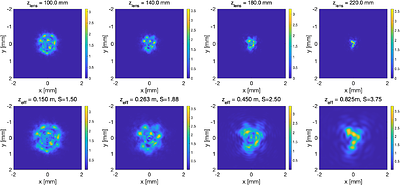
Path-length diversity methods may be used for adaptive optics (AO) systems to retrieve phase and amplitude information by measuring intensity across multiple planes. Observations that rely on free-space propagation, such as the nonlinear curvature wavefront sensor (WFS), have been shown to offer excellent sensitivity and robustness to scintillation. However, the default design results in a large opto-mechanical footprint due to unavoidable geometric-optics and wave-optics effects. Measurements recorded in a convergent beam would improve instrument compactness, while concentrating light into smaller detector regions of interest, improving signal-to-noise ratio and possibly wavefront reconstruction speed. In this paper, we study path-length diversity wavefront sensing using four planes of contemporaneous intensity measurements made in a convergent beam. We develop a physical optics propagation model and validate the model by performing wavefront reconstructions in both simulations and lab experiments. The manuscripts core contribution is a practical, intensity-domain, Fourier-transform-based recipe to use a conventional multi-plane Gerchberg-Saxton (or comparable) reconstruction pipeline with convergent-beam measurements, enabling a compact optical layout. We find that this approach offers practical benefits over an equivalent free-space wavefront sensor, in particular reducing size, weight, complexity and cost. less

By: Slava G. Turyshev
This paper presents a rigorous analytical framework for quantitatively evaluating space-based laser power beaming from lunar-orbiting spacecraft to surface receivers, addressing the critical need for continuous, high-density energy to sustain lunar exploration and habitation. The framework integrates physics-based models of spacecraft photovoltaic generation, precise orbital geometries, time-dependent link availability and slant-range variati... more
This paper presents a rigorous analytical framework for quantitatively evaluating space-based laser power beaming from lunar-orbiting spacecraft to surface receivers, addressing the critical need for continuous, high-density energy to sustain lunar exploration and habitation. The framework integrates physics-based models of spacecraft photovoltaic generation, precise orbital geometries, time-dependent link availability and slant-range variations, coherent beam propagation (including transmitter aperture diameter, beam quality factor, path losses, and pointing jitter), and photonic-to-electrical conversion at the lunar surface. Particular emphasis is placed on phased-array transmitter systems, whose large effective apertures significantly reduce beam divergence relative to single-aperture designs, resulting in orders-of-magnitude increases in delivered surface power under equivalent orbital and power conditions. Parametric sensitivity analyses and illustrative numerical simulations demonstrate how phased-array architectures improve power density and end-to-end efficiency at operational lunar distances. The study also examines advanced orbital configurations (e.g., Near-Rectilinear Halo Orbits, Earth-Moon Lagrange points), real-time adaptive beam steering and wavefront control, optimized receiver geometries, and thermal/dust mitigation strategies. The results establish a clear pathway toward scalable, efficient laser power beaming infrastructures capable of overcoming lunar-specific challenges - including prolonged darkness and permanently shadowed regions - and enabling sustained robotic and crewed surface operations. less


By: Konstantin Beloshenko, Iuliia Riabenko, Sergey Shulga, Nikolai Makarovskii
The article explores optical properties of nanostructures containing spherical gold nanoparticles of various radii. We explore the particle radius as a criterion to select a permittivity model aimed at describing optical absorption spectra of gold granules. The experiments showed splitting of the absorption band of granular gold films to form a second absorption peak. The first peak is associated with the phenomenon of plasmon resonance, whil... more
The article explores optical properties of nanostructures containing spherical gold nanoparticles of various radii. We explore the particle radius as a criterion to select a permittivity model aimed at describing optical absorption spectra of gold granules. The experiments showed splitting of the absorption band of granular gold films to form a second absorption peak. The first peak is associated with the phenomenon of plasmon resonance, while the second one reflects quantum hybridization of energy levels in gold. Quantum effects were shown to prevail over size effects at a granule diameter of about 5-6 nm. The Mie theory gives a rigorous solution for the scattered electromagnetic field on a sphere taking into account optical properties of the latter, however, it does not specify criteria of selecting a model to calculate dielectric permittivity. Both calculations and experiments confirmed the limiting diameter of gold nanoparticles where the Hampe-Shklyarevsky model is applied. Meanwhile, this model was still unable to predict splitting of the plasma absorption band. The data presented in the article can be used for a predetermined local field enhancement in composite media consisting of a biolayer and metal nanoparticles. The conducted research provides a deeper understanding of the influence of a terahertz high-intensity electromagnetic field localized in the space on quantum dots. less