By: Yikai Wu, Ansh Desai, Sho Uemura, Ana M. Botti, Brenda A. Cervantes-Vergara, Fernando Chierchie, Alex Drlica-Wagner, Rouven Essig, Juan Estrada, Erez Etzion, Guillermo Fernandez Moroni, Miqueas Gamero, Stephen E. Holland, Ian Lawson, Steffon Luoma, Nathan A. Saffold, Miguel Sofo-Haro, Javier Tiffenberg, Tomer Volansky
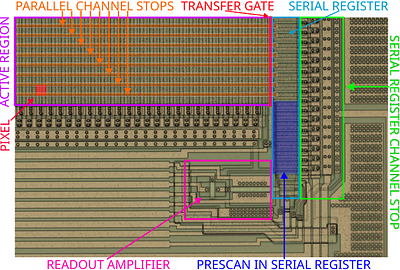
Skipper Charge-Coupled Devices (Skipper-CCDs) are a leading technology in the search for sub-GeV dark matter and coherent elastic neutrino-nucleus scattering. A key background for rare-event searches with these detectors arises from "spurious charge" -- single-electron events generated when charges are transferred through the active region to the serial register, and across the serial register to the readout stage. We present a characterizati... more
Skipper Charge-Coupled Devices (Skipper-CCDs) are a leading technology in the search for sub-GeV dark matter and coherent elastic neutrino-nucleus scattering. A key background for rare-event searches with these detectors arises from "spurious charge" -- single-electron events generated when charges are transferred through the active region to the serial register, and across the serial register to the readout stage. We present a characterization of spurious charge in both the active region and the serial register of SENSEI Skipper-CCDs, and show that, in a well-shielded low-background environment, the dominant contribution originates in the serial register during Skipper readout, when horizontal clocks are held at constant voltage between pixel transfers. Motivated by this finding, we develop a "tri-level" clocking scheme in which the held-low phase is raised to an intermediate voltage during readout to suppress trap-mediated charge generation. Using the SENSEI detector near the MINOS cavern, we measure a serial-register single-electron density of $(2.9 \pm 0.1) \times 10^{-5}$ electrons/pixel/image under standard SENSEI readout conditions, reduced to $(4.0 \pm 0.4) \times 10^{-6}$ electrons/pixel/image with tri-level clocking -- a factor of $\sim$7 improvement. This technique offers a promising path to lower backgrounds in current and future Skipper-CCD experiments. less
By: Julian Cuevas-Zepeda, Joseph Noonan, Claudio Chavez, Miguel Sofo-Haro, Nathan Saffold, Juan Estrada, Kevan Donlon, Chris Leitz, Steve Holland
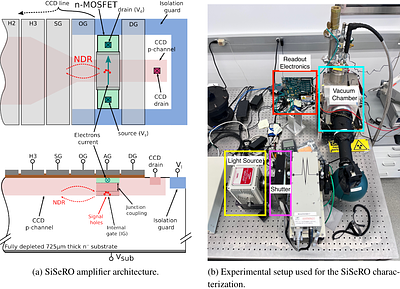
We present an X-ray characterization of a fully depleted, 725 $μ$m thick p-channel SiSeRO CCD. Measurements with a $^{55}$Fe source yield an energy resolution of $54 \pm 0.9$ eV ($14.6 \pm 0.25 e^{-}$) at 5.9 keV for single-pixel events, demonstrating that the SiSeRO amplifier preserves the intrinsic charge resolution of the CCD under multi-sample non-destructive readout. Characterization with a $^{241}$Am source extends the response to highe... more
We present an X-ray characterization of a fully depleted, 725 $μ$m thick p-channel SiSeRO CCD. Measurements with a $^{55}$Fe source yield an energy resolution of $54 \pm 0.9$ eV ($14.6 \pm 0.25 e^{-}$) at 5.9 keV for single-pixel events, demonstrating that the SiSeRO amplifier preserves the intrinsic charge resolution of the CCD under multi-sample non-destructive readout. Characterization with a $^{241}$Am source extends the response to higher-energy photons, with reconstructed spectral features observed between 9-26 keV and the 59.5 keV $γ$ emission. These measurements, together with a muon-derived diffusion calibration, show that charge transport and diffusion are consistent with interactions spanning the full sensor depth. These results demonstrate that the SiSeRO CCD simultaneously achieves sub-electron noise performance and efficient charge collection in a thick, fully depleted silicon detector. This combination enables X-ray spectroscopy across a broad energy range while maintaining sensitivity to faint signals. less
By: Sahla Manithottathil, Anuj Gupta, Mudit Kumar, Navaneeth Poonthottathil
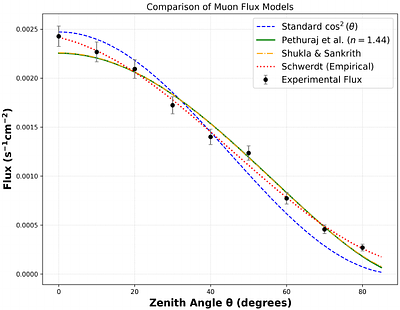
This report presents the design, characterization, and application of a high-sensitivity optical detection system based on plastic scintillators coupled to Multi-Pixel Photon Counters (MPPCs). The primary objective was to evaluate the performance of MPPCs (Silicon Photomultipliers) as robust, low-voltage alternatives to traditional photomultiplier tubes for detecting faint scintillation light. The optoelectronic properties of the sensors were... more
This report presents the design, characterization, and application of a high-sensitivity optical detection system based on plastic scintillators coupled to Multi-Pixel Photon Counters (MPPCs). The primary objective was to evaluate the performance of MPPCs (Silicon Photomultipliers) as robust, low-voltage alternatives to traditional photomultiplier tubes for detecting faint scintillation light. The optoelectronic properties of the sensors were analyzed, including single-photoelectron gain calibration and dark count rate measurements, to optimize the signal-to-noise ratio. By embedding wavelength-shifting fibers to enhance light collection efficiency, the system was configured into a three-fold coincidence telescope. The angular distribution of the cosmic ray muon flux was measured to validate the detector's stability and geometric acceptance. Fitting the experimental data to a $\bm{\cos^n(θ)}$ distribution yielded an angular exponent of $\bm{n = 1.44 \pm 0.06}$, consistent with literature values. These results demonstrate the efficacy of the MPPC-scintillator coupling for precise photon counting and timing applications in high-energy physics instrumentation. less
4 SciCasts by .

By: Gerhard Heinzel, Javier Álvarez-Vizoso, Miguel Dovale-Álvarez
The Laser Interferometer Space Antenna (LISA) will enable direct observations of low-frequency gravitational waves, offering unprecedented insight into astrophysical and cosmological phenomena. LISA's heterodyne interferometric measurement system requires phase-locking five of its six onboard lasers with tunable frequency offsets to ensure that all beatnotes remain within the metrology system's operational range, despite Doppler-induced frequ... more
The Laser Interferometer Space Antenna (LISA) will enable direct observations of low-frequency gravitational waves, offering unprecedented insight into astrophysical and cosmological phenomena. LISA's heterodyne interferometric measurement system requires phase-locking five of its six onboard lasers with tunable frequency offsets to ensure that all beatnotes remain within the metrology system's operational range, despite Doppler-induced frequency shifts. The selection of these offset frequencies -- collectively forming a frequency plan -- is a complex optimization problem constrained by the spacecraft's orbital dynamics and instrument limitations. While previous work established an algorithmic solution for deriving time-dependent frequency plans, this study takes a complementary approach by systematically analyzing and cataloging all possible laser locking configurations. We present an automated method to explore, validate, and classify viable locking schemes, identifying 36 unique non-frequency-swapping configurations and 72 additional frequency-swapping configurations for an arbitrary choice of primary laser. This exhaustive classification provides a foundation for frequency planning across the full range of operational scenarios. less