By: Aleksey Lunkin
We develop a microscopic theory of thermalisation for a thermometer coupled to a many-body bath beyond standard Markovian and Fermi-golden-rule assumptions. By modeling interaction matrix elements in the non-interacting basis as independent random variables, we derive a diffusion-propagator expression for the reduced dynamics and show that relaxation is controlled by the distribution of interaction-induced level broadenings. The theory predic... more
We develop a microscopic theory of thermalisation for a thermometer coupled to a many-body bath beyond standard Markovian and Fermi-golden-rule assumptions. By modeling interaction matrix elements in the non-interacting basis as independent random variables, we derive a diffusion-propagator expression for the reduced dynamics and show that relaxation is controlled by the distribution of interaction-induced level broadenings. The theory predicts a thermalisation timescale set by the inverse typical broadening and yields a non-Markovian generalization of global balance. Exact-diagonalization tests for heavy-tailed L{é}vy couplings, an all-to-all transverse-field Ising model, and the one-dimensional Imbrie model show good agreement with these predictions. less
By: Luciano Loris Viteritti, Riccardo Rende, Giacomo Bracci Testasecca, Jacopo Niedda, Roderich Moessner, Giuseppe Carleo, Antonello Scardicchio
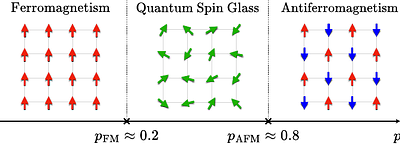
We investigate the two-dimensional frustrated quantum Heisenberg model with bond disorder on nearest-neighbor couplings using the recently introduced Foundation Neural-Network Quantum States framework, which enables accurate and efficient computation of disorder-averaged observables with a single variational optimization. Simulations on large lattices reveal an extended region of the phase diagram where long-range magnetic order vanishes in t... more
We investigate the two-dimensional frustrated quantum Heisenberg model with bond disorder on nearest-neighbor couplings using the recently introduced Foundation Neural-Network Quantum States framework, which enables accurate and efficient computation of disorder-averaged observables with a single variational optimization. Simulations on large lattices reveal an extended region of the phase diagram where long-range magnetic order vanishes in the thermodynamic limit, while the overlap order parameter, which characterizes quantum spin glass states, remains finite. These findings, supported by a semiclassical analysis based on a large-spin expansion, provide compelling evidence that the spin glass phase is stable against quantum fluctuations, unlike the classical case where it disappears at any finite temperature. less

By: Jonathan B. Curtis, Prineha Narang, Victor Galitski
The interplay between disorder and quantum interference leads to a wide
variety of physical phenomena including celebrated Anderson localization -- the
complete absence of diffusive transport due to quantum interference between
different particle trajectories. In two dimensions, any amount of disorder is
thought to induce localization of all states at long enough length scales,
though this may be prevented if bands are topological or have s... more
The interplay between disorder and quantum interference leads to a wide
variety of physical phenomena including celebrated Anderson localization -- the
complete absence of diffusive transport due to quantum interference between
different particle trajectories. In two dimensions, any amount of disorder is
thought to induce localization of all states at long enough length scales,
though this may be prevented if bands are topological or have strong spin-orbit
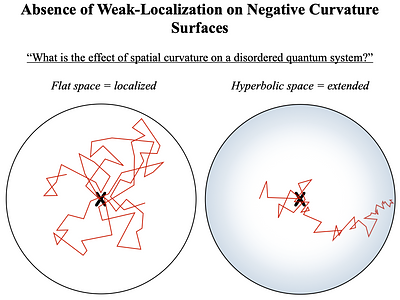
coupling. In this note, we present a simple argument providing another
mechanism for disrupting localization: by tuning the underlying curvature of
the manifold on which diffusion takes place. We show that negative curvature
manifolds contain a natural infrared cut off for the probability of self
returning paths. We provide explicit calculations of the Cooperon -- directly
related to the weak-localization corrections to the conductivity -- in
hyperbolic space. It is shown that constant negative curvature leads to a rapid
growth in the number of available trajectories a particle can coherently
traverse in a given time, reducing the importance of interference effects and
restoring classical diffusive behavior even in the absence of inelastic
collisions. We conclude by arguing that this result may be amenable to
experimental verification through the use of quantum simulators.
less

By: Richard Barney, Michael Winer, Christopher L. Baldwin, Brian Swingle, Victor Galitski
Glasses have the interesting feature of being neither integrable nor fully
chaotic. They thermalize quickly within a subspace but thermalize much more
slowly across the full space due to high free energy barriers which partition
the configuration space into sectors. Past works have examined the
Rosenzweig-Porter (RP) model as a minimal quantum model which transitions from
localized to chaotic behavior. In this work we generalize the RP mode... more
Glasses have the interesting feature of being neither integrable nor fully
chaotic. They thermalize quickly within a subspace but thermalize much more
slowly across the full space due to high free energy barriers which partition
the configuration space into sectors. Past works have examined the
Rosenzweig-Porter (RP) model as a minimal quantum model which transitions from
localized to chaotic behavior. In this work we generalize the RP model in such
a way that it becomes a minimal model which transitions from glassy to chaotic
behavior, which we term the "Block Rosenzweig-Porter" (BRP) model. We calculate
the spectral form factors of both models at all timescales. Whereas the RP
model exhibits a crossover from localized to ergodic behavior at the Thouless
timescale, the new BRP model instead crosses over from glassy to fully chaotic
behavior, as seen by a change in the slope of the ramp of the spectral form
factor.
less
Non-volatile leaky integrate-and-fire neurons with domain walls in antiferromagnetic insulators
2upvotes
By: Johannes W. Austefjord, Verena Brehm, Serban Lepadatu, Alireza Qaiumzadeh
Despite the rapid development of powerful supercomputers in recent years, the
human brain still has some abilities that outperform modern computers which are
based on the von Neumann architecture. The human brain is much more energy
efficient than state-of-the-art digital computers and can at the same time
perform complex tasks such as pattern recognition. The brain-inspired
neuromorphic computing paradigm is a promising path towards next g... more
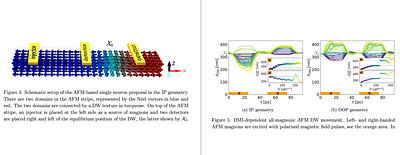
Despite the rapid development of powerful supercomputers in recent years, the
human brain still has some abilities that outperform modern computers which are
based on the von Neumann architecture. The human brain is much more energy
efficient than state-of-the-art digital computers and can at the same time
perform complex tasks such as pattern recognition. The brain-inspired
neuromorphic computing paradigm is a promising path towards next generation
analogue computers with fundamentally different architecture. The building
blocks of the human brain are neurons with leaky integrate-and-fire mechanisms.
In this work, using the advantage of antiferromagnetic insulators, we propose a
non-volatile spintronic-based neuron. In our proposal, an antiferromagnetic
domain wall in the presence of a magnetic anisotropy gradient mimics a
biological neuron with leaky and integrative properties. This single neuron is
controlled by polarized antiferromagnetic magnons, activated by either a
magnetic field pulse or a spin transfer torque mechanism. We propose that this
single neuron, based on antiferromagnetic insulators, is faster and more energy
efficient than other metallic ferromagnetic-based neurons.
less