By: Nathan Lambert, Thomas Krendl Gilbert, Tom Zick
Reinforcement learning from human feedback (RLHF) has emerged as a powerful technique to make large language models (LLMs) easier to use and more effective. A core piece of the RLHF process is the training and utilization of a model of human preferences that acts as a reward function for optimization. This approach, which operates at the intersection of many stakeholders and academic disciplines, remains poorly understood. RLHF reward model... more
Reinforcement learning from human feedback (RLHF) has emerged as a powerful technique to make large language models (LLMs) easier to use and more effective. A core piece of the RLHF process is the training and utilization of a model of human preferences that acts as a reward function for optimization. This approach, which operates at the intersection of many stakeholders and academic disciplines, remains poorly understood. RLHF reward models are often cited as being central to achieving performance, yet very few descriptors of capabilities, evaluations, training methods, or open-source models exist. Given this lack of information, further study and transparency is needed for learned RLHF reward models. In this paper, we illustrate the complex history of optimizing preferences, and articulate lines of inquiry to understand the sociotechnical context of reward models. In particular, we highlight the ontological differences between costs, rewards, and preferences at stake in RLHF's foundations, related methodological tensions, and possible research directions to improve general understanding of how reward models function. less
By: Janet Egan, Lennart Heim
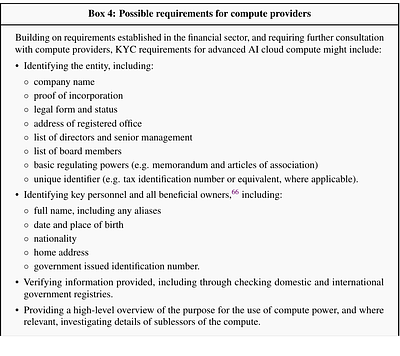
To address security and safety risks stemming from highly capable artificial intelligence (AI) models, we propose that the US government should ensure compute providers implement Know-Your-Customer (KYC) schemes. Compute - the computational power and infrastructure required to train and run these AI models - is emerging as a node for oversight. KYC, a standard developed by the banking sector to identify and verify client identity, could pro... more
To address security and safety risks stemming from highly capable artificial intelligence (AI) models, we propose that the US government should ensure compute providers implement Know-Your-Customer (KYC) schemes. Compute - the computational power and infrastructure required to train and run these AI models - is emerging as a node for oversight. KYC, a standard developed by the banking sector to identify and verify client identity, could provide a mechanism for greater public oversight of frontier AI development and close loopholes in existing export controls. Such a scheme has the potential to identify and warn stakeholders of potentially problematic and/or sudden advancements in AI capabilities, build government capacity for AI regulation, and allow for the development and implementation of more nuanced and targeted export controls. Unlike the strategy of limiting access to AI chip purchases, regulating the digital access to compute offers more precise controls, allowing regulatory control over compute quantities, as well as the flexibility to suspend access at any time. To enact a KYC scheme, the US government will need to work closely with industry to (1) establish a dynamic threshold of compute that effectively captures high-risk frontier model development, while minimizing imposition on developers not engaged in frontier AI; (2) set requirements and guidance for compute providers to keep records and report high-risk entities; (3) establish government capacity that allows for co-design, implementation, administration and enforcement of the scheme; and (4) engage internationally to promote international alignment with the scheme and support its long-term efficacy. While the scheme will not address all AI risks, it complements proposed solutions by allowing for a more precise and flexible approach to controlling the development of frontier AI models and unwanted AI proliferation. less

By: Thorsten Ruprechter, Manoel Horta Ribeiro, Robert West, Denis Helic
Wikipedia, the Web's largest encyclopedia, frequently faces content disputes or malicious users seeking to subvert its integrity. Administrators can mitigate such disruptions by enforcing "page protection" that selectively limits contributions to specific articles to help prevent the degradation of content. However, this practice contradicts one of Wikipedia's fundamental principles$-$that it is open to all contributors$-$and may hinder fur... more
Wikipedia, the Web's largest encyclopedia, frequently faces content disputes or malicious users seeking to subvert its integrity. Administrators can mitigate such disruptions by enforcing "page protection" that selectively limits contributions to specific articles to help prevent the degradation of content. However, this practice contradicts one of Wikipedia's fundamental principles$-$that it is open to all contributors$-$and may hinder further improvement of the encyclopedia. In this paper, we examine the effect of page protection on article quality to better understand whether and when page protections are warranted. Using decade-long data on page protections from the English Wikipedia, we conduct a quasi-experimental study analyzing pages that received "requests for page protection"$-$written appeals submitted by Wikipedia editors to administrators to impose page protections. We match pages that indeed received page protection with similar pages that did not and quantify the causal effect of the interventions on a well-established measure of article quality. Our findings indicate that the effect of page protection on article quality depends on the characteristics of the page prior to the intervention: high-quality articles are affected positively as opposed to low-quality articles that are impacted negatively. Subsequent analysis suggests that high-quality articles degrade when left unprotected, whereas low-quality articles improve. Overall, with our study, we outline page protections on Wikipedia and inform best practices on whether and when to protect an article. less
By: Qichao Wang, Tian Bian, Yian Yin, Tingyang Xu, Hong Cheng, Helen M. Meng, Zibin Zheng, Liang Chen, Bingzhe Wu
The recent surge in the research of diffusion models has accelerated the adoption of text-to-image models in various Artificial Intelligence Generated Content (AIGC) commercial products. While these exceptional AIGC products are gaining increasing recognition and sparking enthusiasm among consumers, the questions regarding whether, when, and how these models might unintentionally reinforce existing societal stereotypes remain largely unaddr... more
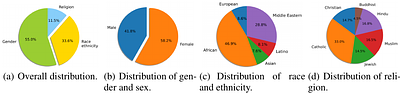
The recent surge in the research of diffusion models has accelerated the adoption of text-to-image models in various Artificial Intelligence Generated Content (AIGC) commercial products. While these exceptional AIGC products are gaining increasing recognition and sparking enthusiasm among consumers, the questions regarding whether, when, and how these models might unintentionally reinforce existing societal stereotypes remain largely unaddressed. Motivated by recent advancements in language agents, here we introduce a novel agent architecture tailored for stereotype detection in text-to-image models. This versatile agent architecture is capable of accommodating free-form detection tasks and can autonomously invoke various tools to facilitate the entire process, from generating corresponding instructions and images, to detecting stereotypes. We build the stereotype-relevant benchmark based on multiple open-text datasets, and apply this architecture to commercial products and popular open source text-to-image models. We find that these models often display serious stereotypes when it comes to certain prompts about personal characteristics, social cultural context and crime-related aspects. In summary, these empirical findings underscore the pervasive existence of stereotypes across social dimensions, including gender, race, and religion, which not only validate the effectiveness of our proposed approach, but also emphasize the critical necessity of addressing potential ethical risks in the burgeoning realm of AIGC. As AIGC continues its rapid expansion trajectory, with new models and plugins emerging daily in staggering numbers, the challenge lies in the timely detection and mitigation of potential biases within these models. less
By: Xiao-Jian Chen, Changjiang Xiao, Zhou Huanga, Keli Wang, Weiyu Zhang, Yu Liu
Due to the large volume of recording, the complete spontaneity, and the flexible pick-up and drop-off locations, taxi data portrays a realistic and detailed picture of urban space use to a certain extent. The spatial arrangement of pick-up and drop-off hotspots reflects the organizational space, which has received attention in urban structure studies. Previous studies mainly explore the hotspots at a large scale by visual analysis or some s... more
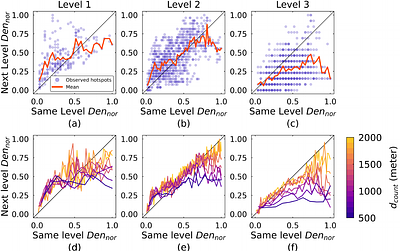
Due to the large volume of recording, the complete spontaneity, and the flexible pick-up and drop-off locations, taxi data portrays a realistic and detailed picture of urban space use to a certain extent. The spatial arrangement of pick-up and drop-off hotspots reflects the organizational space, which has received attention in urban structure studies. Previous studies mainly explore the hotspots at a large scale by visual analysis or some simple indexes, where the hotspots usually cover the entire central business district, train stations, or dense residential areas, reaching a radius of hundreds or even thousands of meters. However, the spatial arrangement patterns of small-scale hotspots, reflecting the specific popular pick-up and drop-off locations, have not received much attention. Using two taxi trajectory datasets in Wuhan and Beijing, China, this study quantitatively explores the spatial arrangement of fine-grained pick-up and drop-off local hotspots with different levels of popularity, where the sizes are adaptively set as 90m*90m in Wuhan and 105m*105m in Beijing according to the local hotspot identification method. Results show that popular hotspots tend to be surrounded by less popular hotspots, but the existence of less popular hotspots is inhibited in regions with a large number of popular hotspots. We use the terms hierarchical accompany and inhibiting patterns for these two spatial configurations. Finally, to uncover the underlying mechanism, a KNN-based model is proposed to reproduce the spatial distribution of other less popular hotspots according to the most popular ones. These findings help decision-makers construct reasonable urban minimum units for precise traffic and disease control, as well as plan a more humane spatial arrangement of points of interest. less

By: Carolina Camassa
In the rapidly evolving field of crypto-assets, white papers are essential documents for investor guidance, and are now subject to unprecedented content requirements under the EU's Markets in Crypto-Assets Regulation (MiCAR). Natural Language Processing can serve as a powerful tool for both analyzing these documents and assisting in regulatory compliance. This paper delivers two contributions to the topic. First, we survey existing applicat... more
In the rapidly evolving field of crypto-assets, white papers are essential documents for investor guidance, and are now subject to unprecedented content requirements under the EU's Markets in Crypto-Assets Regulation (MiCAR). Natural Language Processing can serve as a powerful tool for both analyzing these documents and assisting in regulatory compliance. This paper delivers two contributions to the topic. First, we survey existing applications of textual analysis to unregulated crypto-asset white papers, uncovering a research gap that could be bridged with interdisciplinary collaboration. We then conduct an analysis of the changes introduced by MiCAR, highlighting the opportunities and challenges of integrating NLP within the new regulatory framework. Our findings set the stage for further research, with the potential to benefit regulators, crypto-asset issuers, and investors. less

By: Sebastian Zezulka, Konstantin Genin
Deploying an algorithmically informed policy is a significant intervention in the structure of society. As is increasingly acknowledged, predictive algorithms have performative effects: using them can shift the distribution of social outcomes away from the one on which the algorithms were trained. Algorithmic fairness research is usually motivated by the worry that these performative effects will exacerbate the structural inequalities that ... more
Deploying an algorithmically informed policy is a significant intervention in the structure of society. As is increasingly acknowledged, predictive algorithms have performative effects: using them can shift the distribution of social outcomes away from the one on which the algorithms were trained. Algorithmic fairness research is usually motivated by the worry that these performative effects will exacerbate the structural inequalities that gave rise to the training data. However, standard retrospective fairness methodologies are ill-suited to predict these effects. They impose static fairness constraints that hold after the predictive algorithm is trained, but before it is deployed and, therefore, before performative effects have had a chance to kick in. However, satisfying static fairness criteria after training is not sufficient to avoid exacerbating inequality after deployment. Addressing the fundamental worry that motivates algorithmic fairness requires explicitly comparing the change in relevant structural inequalities before and after deployment. We propose a prospective methodology for estimating this post-deployment change from pre-deployment data and knowledge about the algorithmic policy. That requires a strategy for distinguishing between, and accounting for, different kinds of performative effects. In this paper, we focus on the algorithmic effect on the causally downstream outcome variable. Throughout, we are guided by an application from public administration: the use of algorithms to (1) predict who among the recently unemployed will stay unemployed for the long term and (2) targeting them with labor market programs. We illustrate our proposal by showing how to predict whether such policies will exacerbate gender inequalities in the labor market. less
By: Valentijn Braun, Debarati Bhaumik, Diptish Dey
Albeit the widespread application of recommender systems (RecSys) in our daily lives, rather limited research has been done on quantifying unfairness and biases present in such systems. Prior work largely focuses on determining whether a RecSys is discriminating or not but does not compute the amount of bias present in these systems. Biased recommendations may lead to decisions that can potentially have adverse effects on individuals, sensi... more
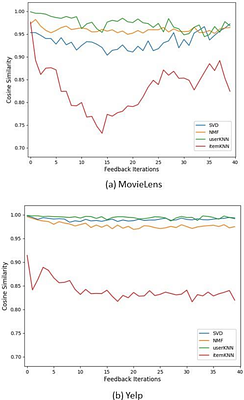
Albeit the widespread application of recommender systems (RecSys) in our daily lives, rather limited research has been done on quantifying unfairness and biases present in such systems. Prior work largely focuses on determining whether a RecSys is discriminating or not but does not compute the amount of bias present in these systems. Biased recommendations may lead to decisions that can potentially have adverse effects on individuals, sensitive user groups, and society. Hence, it is important to quantify these biases for fair and safe commercial applications of these systems. This paper focuses on quantifying popularity bias that stems directly from the output of RecSys models, leading to over recommendation of popular items that are likely to be misaligned with user preferences. Four metrics to quantify popularity bias in RescSys over time in dynamic setting across different sensitive user groups have been proposed. These metrics have been demonstrated for four collaborative filtering based RecSys algorithms trained on two commonly used benchmark datasets in the literature. Results obtained show that the metrics proposed provide a comprehensive understanding of growing disparities in treatment between sensitive groups over time when used conjointly. less
By: Anna Andreychenko, Viktoriia Korzhuk, Stanislav Kondratenko, Polina Cheraneva
Currently, there are many difficulties regarding the interoperability of medical data and related population data sources. These complications get in the way of the generation of high-quality data sets at city, region and national levels. Moreover, the collection of datasets within large medical centers is feasible due to own IT departments whereas the collection of raw medical data from multiple organizations is a more complicated process.... more
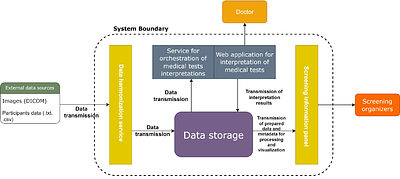
Currently, there are many difficulties regarding the interoperability of medical data and related population data sources. These complications get in the way of the generation of high-quality data sets at city, region and national levels. Moreover, the collection of datasets within large medical centers is feasible due to own IT departments whereas the collection of raw medical data from multiple organizations is a more complicated process. In these circumstances, the most appropriate option is to develop digital products based on microservice architecture. Because of this approach, it is possible to ensure the multimodality of the system, the flexibility of the interface and the internal system approach, when interconnected elements behave as a whole, demonstrating behavior different from the behavior when working independently. These conditions allow, in turn, to ensure the maximum number and representativeness of the resulting data sets. This paper demonstrates a concept of the platform for a sustainable generation of quality and reliable sets of multimodal medical data. It collects data from different external sources, harmonizes it using a special service, anonymizes harmonized data, and labels processed data. The proposed system aims to be a promising solution to the improvement of medical data quality for machine learning. less
By: Sadasivan Shankar
Estimates of energy usage in layers of computing from devices to algorithms have been determined and analyzed. Building on the previous analysis [3], energy needed from single devices and systems including three large-scale computing applications such as Artificial Intelligence (AI)/Machine Learning for Natural Language Processing, Scientific Simulations, and Cryptocurrency Mining have been estimated. In contrast to the bit-level switching,... more
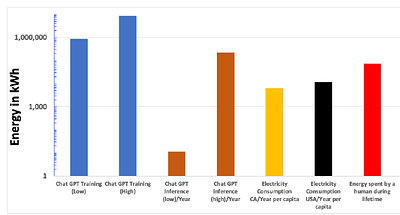
Estimates of energy usage in layers of computing from devices to algorithms have been determined and analyzed. Building on the previous analysis [3], energy needed from single devices and systems including three large-scale computing applications such as Artificial Intelligence (AI)/Machine Learning for Natural Language Processing, Scientific Simulations, and Cryptocurrency Mining have been estimated. In contrast to the bit-level switching, in which transistors achieved energy efficiency due to geometrical scaling, higher energy is expended both at the at the instructions and simulations levels of an application. Additionally, the analysis based on AI/ML Accelerators indicate that changes in architectures using an older semiconductor technology node have comparable energy efficiency with a different architecture using a newer technology. Further comparisons of the energy in computing systems with the thermodynamic and biological limits, indicate that there is a 27-36 orders of magnitude higher energy requirements for total simulation of an application. These energy estimates underscore the need for serious considerations of energy efficiency in computing by including energy as a design parameter, enabling growing needs of compute-intensive applications in a digital world. less