By: Juan Diego Toscano, Sascha Ranftl, Zhiwei Gao, Li-Lian Wang, George Em Karniadakis
Machine-learning surrogates in computational science often require not only accurate predictions but also expectations, variances, conserved integrals, and normalization constants. Conventional neural networks, including Kolmogorov--Arnold networks (KANs), generally evaluate these quantities through Monte Carlo sampling or multidimensional quadrature, making repeated inference costly, particularly in high dimensions. We introduce KANs with Tr... more
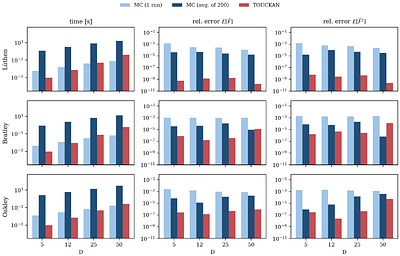
Machine-learning surrogates in computational science often require not only accurate predictions but also expectations, variances, conserved integrals, and normalization constants. Conventional neural networks, including Kolmogorov--Arnold networks (KANs), generally evaluate these quantities through Monte Carlo sampling or multidimensional quadrature, making repeated inference costly, particularly in high dimensions. We introduce KANs with Tractable Operators for Uncertainty and Constraints (TOUCKANs), whose finite-degree polynomial outer functions yield a decomposable sum--product representation. Under factorizing input measures, expectations and higher moments then reduce algebraically to deterministic recursions over one-dimensional leaf integrals. Independent and shared inner-block variants form a parameter-efficiency hierarchy, and a universal-approximation proof for its most restricted member extends to the complete class. The same deterministic operators allow conserved integrals and normalization to be imposed throughout training. Across uniform and Gaussian benchmarks through 50 dimensions, deterministic mean and variance errors remained below the median fixed-budget Monte Carlo errors in every case. TOUCKANs also conserved Cahn--Hilliard mass to machine precision and imposed normalization and orthogonality through deterministic moments, enabling joint computation of the lowest four Schrödinger eigenpairs in two, three, and five dimensions. TOUCKANs therefore connect KAN approximation with tractable probabilistic circuits, making statistical operators and integral constraints directly available within an expressive neural surrogate. less

By: Zheng Zhang
When stochastic field dynamics are cast into a path-integral formulation, perturbation theory becomes systematic but the resulting expansion quickly grows combinatorially large. The setting targeted here includes multi-component, multi-dimensional fields with matrix propagators, tensor-valued couplings, and non-Gaussian driving noise specified by arbitrary $n$-point cumulants. Wick pairings grow factorially, and component indices must be rout... more
When stochastic field dynamics are cast into a path-integral formulation, perturbation theory becomes systematic but the resulting expansion quickly grows combinatorially large. The setting targeted here includes multi-component, multi-dimensional fields with matrix propagators, tensor-valued couplings, and non-Gaussian driving noise specified by arbitrary $n$-point cumulants. Wick pairings grow factorially, and component indices must be routed through the tensor-valued vertices. The useful output is not a raw contraction list, but a diagram table: one entry per topology, with multiplicities, coupling sums, signs, and causal constraints resolved. We present sft-wick, an open-source Python package that constructs these diagram tables and computes their integrals numerically. Given an action and an observable, it enumerates topologically distinct Feynman diagrams, derives their algebraic coefficients, and evaluates the resulting diagram integrals from user-supplied response and cumulant functions. The core algorithm enumerates spatial topologies before routing component indices, avoiding contraction-by-contraction Wick expansion. Response-field constraints, including vanishing response-response contractions, the ito prescription, and the absence of causal response loops, are enforced during enumeration. Predictions are validated against direct Langevin simulation, agreeing to within the simulation's statistical noise. less
