OmicGlaze: Spatial Multi-Omic Mapping of Traumatic Brain Injury

OmicGlaze: Spatial Multi-Omic Mapping of Traumatic Brain Injury
Li, Y.; Neuffer, S. J.; Wider, J.; Ma, S.; Zhao, N.; McCracken, L.; Sanderson, T.; Dong, J.-f.; Deng, Y.; Xiao, Y.
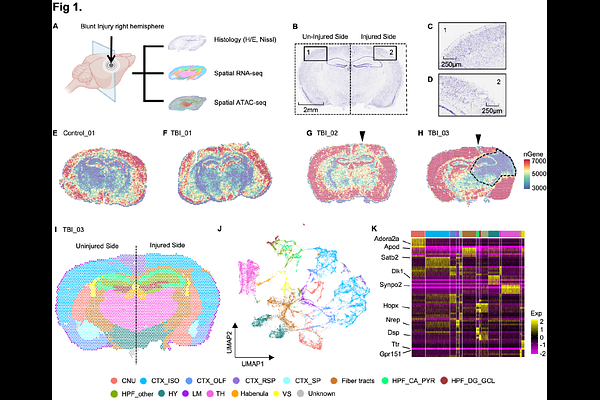
AbstractTraumatic brain injury (TBI) is a major cause of mortality and long-term disability worldwide, giving rise to complex neurological complications that impact millions of individuals each year. Cellular stress and neuronal injury vary dramatically across cortical layers, vascular niches, and between the ipsilateral (injured) or contralateral (uninjured) hemispheres. There is a critical need for quantitative measures that capture the spatial distribution of injury-induced cellular changes, as well as the gene regulatory elements that drive them. Here, we developed OmicGlaze, an experimental and computational workflow for systematically profiling the spatial transcriptome and epigenome of mouse brains following mild traumatic brain injury. We established a spatial scoring system, and identified region-specific biological processes post injury, including changes in neuronal activities, cellular stress, immune response, and gliosis. Spatial assay for transposase-accessible chromatin with sequencing (Spatial ATAC-seq) generated the first epigenetic map of traumatic brain injury near single-cell resolution. Notably, we identified the Activator Protein-1 family transcription factor Atf3 as a key gene regulator of injury-induced cellular stress. Together, these spatial multi-omics analyses revealed gene regulatory network in TBI and provided a broadly applicable framework for dissecting cellular and molecular mechanisms underlying complex neurological disorders.