Heterologous Rieske non-heme iron monooxygenases enable efficient microbial conversion of lignin guaiacol to adipic acid

Heterologous Rieske non-heme iron monooxygenases enable efficient microbial conversion of lignin guaiacol to adipic acid
Steele, J.; Wackwitz, C.; Walker, G.; Selvy, K. T.; Wallace, S.
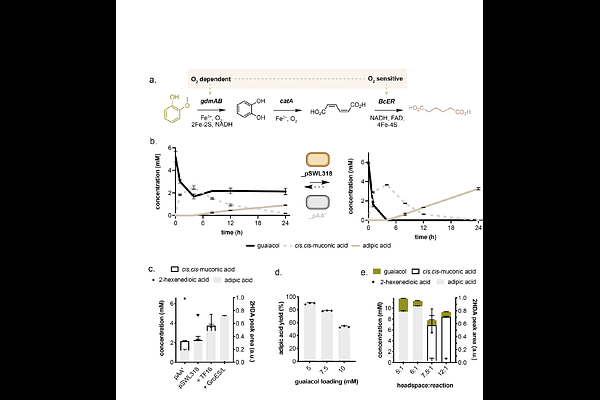
AbstractAdipic acid (1,6-hexanedioic acid) is a key building block for nylon-6,6, a widely used polymer in the global chemical industry. Current industrial production relies on petrochemical feedstocks and nitric acid oxidation of cyclohexane/cyclohexanol mixtures, releasing nitrous oxide, a potent greenhouse gas. Biotechnological routes offer sustainable alternatives but have been limited by low yields or reliance on multi-strain systems. Here we report a one-pot, single-strain microbial process for the efficient conversion of guaiacol - a lignin derived aromatic - into adipic acid. By integrating heterologous Rieske non-heme iron monooxygenases from Cupriavidus necator N-1 with systematic process optimisations in engineered Escherichia coli, we achieve near-quantitative conversion with 97% yield and titres of 1.5 g/L in aqueous, lab-scale reactions. This work demonstrates a novel and efficient strategy for lignin valorisation through engineered microbial synthesis, providing a new sustainable and scalable route to adipic acid.