A pectin-based formulation protects milk fat globule membranes in stored human milk

A pectin-based formulation protects milk fat globule membranes in stored human milk
Silpe, J. E.; Kim, H.; ShahLyng, A.; Tsai, Y.-T.; Johnson, K. E.; Kim, B. J.; Slupsky, C. M.; Taha, A. Y.; Dallas, D. C.; Budin, I.; Bassler, B. L.
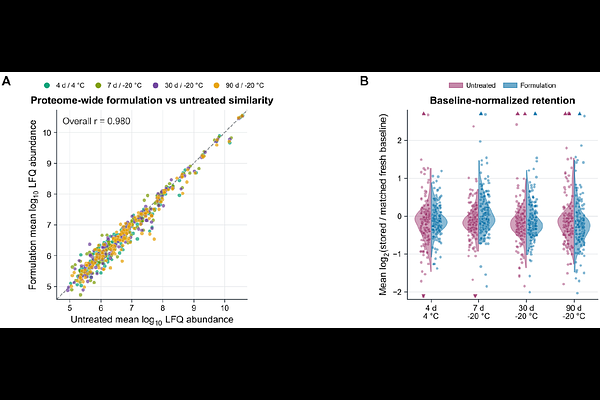
AbstractDuring household storage, expressed human milk can develop odor and flavor changes that trigger infant refusal and lead caregivers to discard their saved milk supply. We show that typical refrigeration and freezing conditions disrupt the milk fat globule membrane (MFGM), exposing milk lipids to lipases that catalyze hydrolysis and oxidation. A pectin-based formulation (PBF) maintains MFGM integrity during storage and following lipase challenge, suppressing production of glycerol, free fatty acid, and oxylipin byproducts without broadly affecting milk macronutrients, the proteome, and culturable microbial burden. Across an independent cohort of lactating individuals, lipase activity varied but tracked with maternal milk lipase gene expression, implicating endogenous lipolysis in stored-milk deterioration. In a blinded olfactory panel, PBF-treated, lipase-challenged milk smelled more like fresh milk than untreated controls. Together, these findings show that stabilizing the MFGM can protect stored human milk from lipase-driven deterioration, preserve sensory quality, and support use for infant feeding.