A high aneuploidy supply rate underlies parallel evolution of fluconazole resistance in Saccharomyces cerevisiae

A high aneuploidy supply rate underlies parallel evolution of fluconazole resistance in Saccharomyces cerevisiae
Sakrikar, S.; Agrawal, A.; Suresh, I.; Gresham, D.
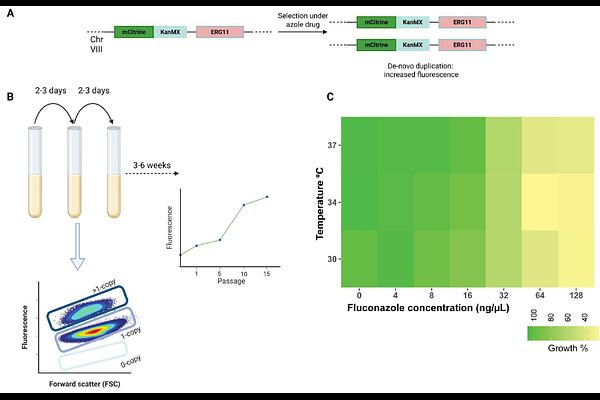
AbstractCopy number variants (CNVs) of ERG11 play a major role in acquisition of resistance to the commonly used azole family of antifungal drugs in many pathogenic yeast species. However, the conditions in which these CNVs arise, and the factors that underlie their emergence and selection in evolving populations, remain poorly understood. Here, we studied the dynamics of de novo CNVs at the ERG11 locus in Saccharomyces cerevisiae to determine the effect of different drug concentrations and temperatures on CNV formation and selection. We found that ERG11 CNVs emerge reproducibly at fluconazole concentrations around the IC50. With increases in temperature, CNVs emerged more rapidly and had a higher tendency towards fixation. Evolved ERG11 CNV strains provided a significant growth advantage across a narrow range of fluconazole concentrations near the IC50 of the wildtype strain. Whole genome sequencing of 35 independent evolved lineages revealed that all ERG11 CNVs are aneuploidies of chromosome VIII. Relocation of ERG11 to chromosome XI also results exclusively in selection for chromosome XI aneuploids. We show that fluconazole does not increase the frequency at which aneuploids are generated. Therefore, we conclude that a high spontaneous rate of aneuploidy formation underlies recurrent acquisition of resistance to fluconazole in a temperature and drug concentration dependent manner.