Molecular modeling of Proteinase-Activated Receptor 1 in complex with Thrombin Receptor Activator Peptide 6.

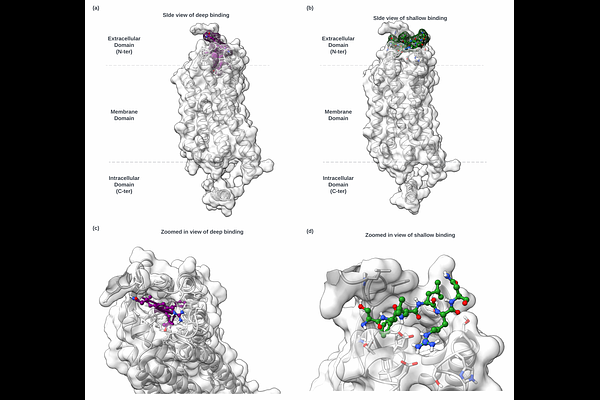
Molecular modeling of Proteinase-Activated Receptor 1 in complex with Thrombin Receptor Activator Peptide 6.
Reboul, E.; Hamawi, D.; Pasquali, S.; Gaussem, P.; Rossi, E.; Taly, A.
AbstractThe protease-activated receptor 1 (PAR1) and its activator thrombin receptor activator peptide 6 (TRAP6) play crucial roles in various physiological and pathological processes, including hemostasis, thrombosis, and cancer progression. Although the interaction between PAR1 and TRAP6 has been heavily studied using experimental technique such as mutagenesis, structural data remains scarce due to the technical hardship of studying membrane proteins such as PAR1. In this study, we employed an integrative modeling approach to elucidate the structure of the PAR1-TRAP6 complex. Leveraging state-of-the-art AI- based protein modeling tools, including AlphaFold2 and ESMFOLD, we integrated HADDOCK, a physics-based method to refine predictions. Overall, the predicted structures are in good agreement with the experimental data available in the literature. Our model unveiled a new T-shaped pi-stacking interaction between TRAP6\'s F2 and PAR1\'s Y360. The integrative modeling approach combining the predictions of the deep learning model with a physics-based method proves to be an interesting strategy for solving challenging membrane protein structures with high confidence. Our model of the PAR1-TRAP6 complex will be an interesting starting point for further investigation of the activation of PAR1 by TRAP6.