Application of the Bradley-Terry model to quantify components of sperm competition

Application of the Bradley-Terry model to quantify components of sperm competition
Afkhami, M.; Li, M. L.; Liang, C.; Patel, P. H.; Buehner, N. A.; Wolfner, M. F.; Clark, A. G.
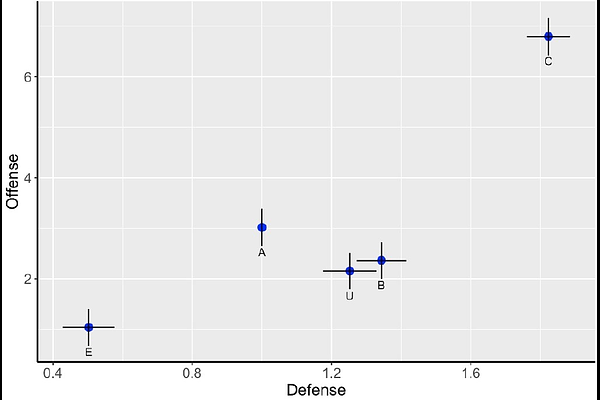
AbstractIn many species with female sperm storage, ejaculates from multiple males overlap in the female reproductive tract, making sperm competitive ability a key component of male reproductive fitness and a target of rapid evolutionary change in the underlying genes. Here, we used controlled laboratory assays of Drosophila melanogaster sperm competition, with doubly-mated females and paternity assignment of offspring, to ask whether a Bradley-Terry framework can effectively summarize and predict competitive outcomes. The Bradley-Terry model is a probabilistic approach that estimates a latent ability score for each contestant based on outcomes of pairwise contests, and thus is naturally suited to data from sperm competition, which are intrinsically pairwise. We selected five distinct male genotypes: four carried strongly expressed RFP or GFP markers that allowed us to distinguish their heterozygous offspring under UV illumination, and the fifth was Canton-S, a standard wild-type genotype that served as our reference. Using Canton-S females, we assayed all 20 ordered pairwise combinations of first and second male, recorded successful double matings, and quantified the offspring sired by each male. We then extended the Bradley-Terry model to estimate genotype-specific competitive success separately for first-male defense (fertilization success following initial mating, also called P1) and second-male offense (fertilization success following a remating, also called P2). This framework provides a flexible and efficient way to integrate results across large arrays of pairwise mating tests and to derive predictive scores for sperm competitive performance.