AI-guided Protein Inhibitor Design for Modulating FAD-dependent Glucose Dehydrogenase Redox Output

AI-guided Protein Inhibitor Design for Modulating FAD-dependent Glucose Dehydrogenase Redox Output
Lee, S.; Tak, E.-J.; Shim, H.-J.; Ahn, W.-C.; Park, K.-H.; Go, S.-R.; Yang, H.; Woo, E.-J.
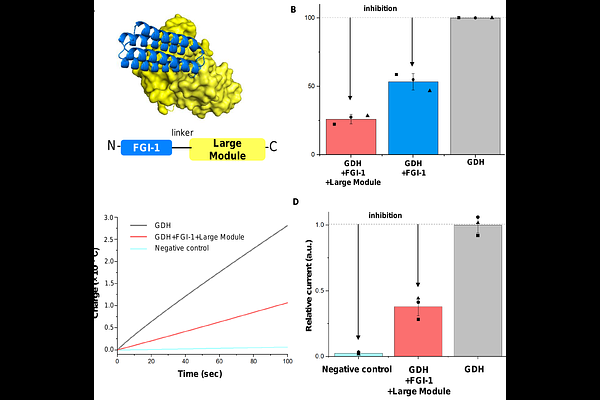
AbstractFlavin adenine dinucleotide-dependent glucose dehydrogenase (FAD-GDH) is a redox enzyme widely used in glucose monitoring, bioelectronic devices, and enzymatic biofuel cells because of its oxygen-independent catalysis and compatibility with electron-transfer processes. However, protein-based regulators that directly bind GDH and modulate its redox output remain underdeveloped. Here, we present an AI-guided strategy for developing a de novo protein inhibitor targeting FAD-GDH. GDH-targeting candidates generated through structure-based computational design were evaluated by yeast surface display and fluorescence-activated cell sorting, leading to the identification of FAD-GDH inhibitor-1 (FGI-1) as a GDH-targeting inhibitory scaffold. Purified His-MBP-FGI-1 reduced GDH-mediated DCIP reduction, demonstrating attenuation of GDH-derived redox output. Random mutagenesis followed by secondary FACS screening yielded evolved variants with increased GDH-binding signals and enhanced redox-output suppression, showing that the de novo inhibitory scaffold could be functionally tuned through experimental evolution. In addition, an FGI-1-based construct fused to a larger protein module retained GDH-output suppressive activity, and electrode-based measurements showed reduced GDH-derived current output. Because electrode-associated measurements may be influenced by protein-mediated surface shielding and altered electron-transfer accessibility, this decrease was interpreted conservatively as attenuation of GDH-derived electrochemical output rather than direct evidence of active-site inhibition. Together, this work establishes an AI-guided design-validation workflow for developing protein inhibitors that modulate FAD-GDH redox output and provides a foundation for protein-level control of enzyme output in biosensing and bioelectronic applications.