Integrated genomics and transcriptomics reveal mechanisms of extreme dietary adaptation in vampire bats

Integrated genomics and transcriptomics reveal mechanisms of extreme dietary adaptation in vampire bats
Liu, S.; Freitas, M. B.; Sartori, S. S. R.; Albertini, M.; Leushkin, E.; van Tussenbroek, I. A.; Morales, A. E.; Pippel, M.; Brown, T.; de Sousa, A. F. R.; de Paula, R. A.; Patmanidis, I.; Jespers, W.; Hilgers, L.; Yi, X.; Bein, B.; Malovichko, Y.; Schell, T.; Greve, C.; Winkler, S.; Hamadou, A. B.; Blumer, M.; Prange, G.; Cueria, J. C. H.; Koessl, M.; Winter, Y.; Dilrosun, S.; Bechan, S. D.; Engstrom, M. D.; Jafferally, D.; Norman, Z.; Sornoza, F.; Davalos, L. M.; Lim, B.; Vernes, S.; Hiller, M.
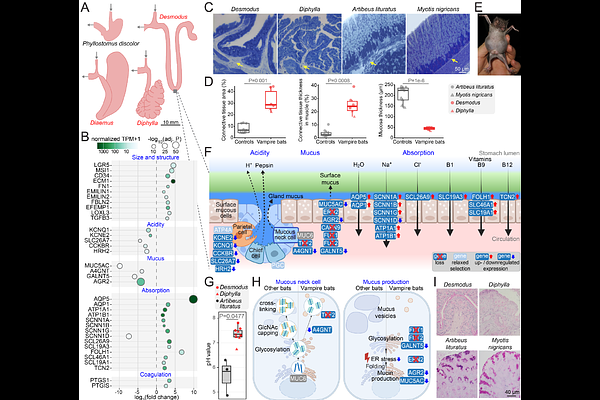
AbstractVampire bats are the only tetrapods that feed exclusively on blood. To uncover the molecular basis of this extreme dietary specialization, we generated six new reference genomes, including genomes of all three vampire bat species, and integrated comparative analyses of gene sequence evolution (selection signatures, duplications, and losses) with transcriptomic data from six major organs to identify shifts in gene expression. Our integrative analyses reveal sequence or expression changes in 150 genes that illuminate the genetic mechanisms underlying sanguivory. Through comparative analyses and experiments, we show that the enlarged vampire bat stomach has increased connective tissue content enabling extreme expansion, is pH-neutral, and exhibits reduced mucus production, together providing molecular insights into its shift from a digestive to an absorptive organ for water, electrolytes, and vitamins. We further uncover pathway-level molecular changes underlying altered gastrointestinal motility; trypsin-dependent protein digestion; upregulated amino acid catabolism with key aspects diverging from other mammals; impaired dietary fat digestion counterbalanced by increased fatty acid synthesis; defective sugar metabolism and natural insulin deficiency; enhanced heme iron absorption; and adult splenic erythropoiesis. Together, these findings reveal the molecular adaptations that enable one of the most extreme dietary transitions among vertebrates.