Glutamine Metabolism Supports α cell Mass and Glucagon Secretion

Glutamine Metabolism Supports α cell Mass and Glucagon Secretion
Schornack, A. M. R.; Rodgers, T. J.; Shou, M.; Siv, W. A.; Yin, L.; Sellick, K.; Chigurupati, V.; Debo, J.; Saraf, S.; Nickles, P. G.; Park, S.; Gibson, S. E.; Shankar, N.; Dobson, J. R.; Behara, S.; Stanley, J. E.; Ehara, A.; Wimalarathne, M.; Crabtree, A.; Reuter, A.; Attie, A. D.; Zaganjor, E.; Coate, K. C.; Li, Y.; Rathmell, J. C.; Keller, M. P.; Jacobson, D. A.; Chen, W.; Dean, E. D.
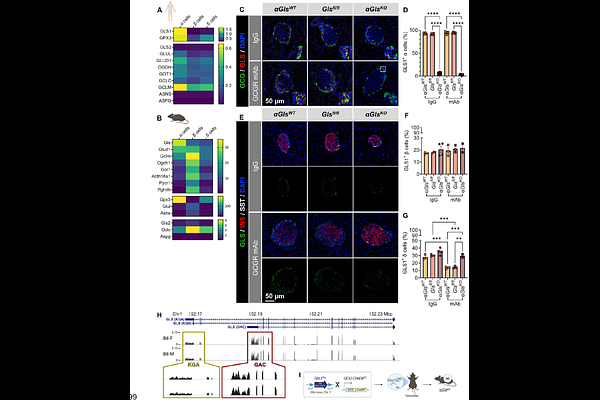
AbstractThe liver- cell axis is a finely tuned biological rheostat that regulates whole body amino acid availability. Pancreatic cells secrete glucagon that regulates amino acid catabolism through gluconeogenesis and ureagenesis, yet the mechanisms linking amino acid levels to cell growth and function are not fully understood. Here, we identify glutaminase, the enzyme that catalyzes glutamine catabolism, as a critical cell regulator. Glutaminase is highly enriched in cells across species. cell expression of glutaminase is required for nutrient-dependent mTORC1 activation, suppression of AMPK signaling, and sustained expression of the glutamine transporter SLC38A5. This establishes a feed-forward loop linking glutamine metabolism to amino acid sensing and growth. Reduced glutaminase activity impairs dynamic glucagon secretion in response to low glucose and amino acids. Together, these findings highlight the importance of glutamine metabolism in cell growth and hormone secretion and suggest it may play a role in cell adaptation to hyperaminoacidemia.