Programmable bacterial adhesion to plastic surfaces for enhanced biodegradation

Programmable bacterial adhesion to plastic surfaces for enhanced biodegradation
Schneier, A.; Armijo-Galdames, B. O.; Lau, E. C. H. T.; Sadler, J. C.
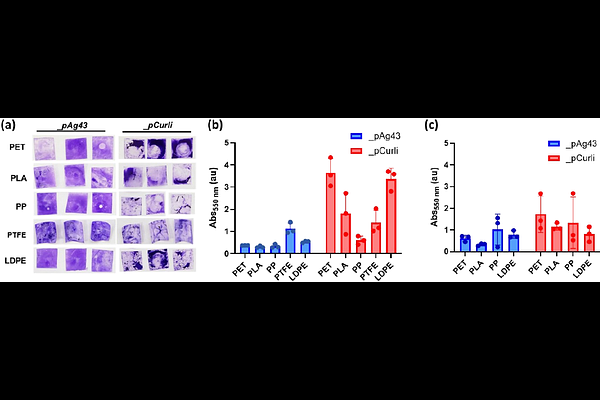
AbstractColonisation of plastic surfaces by microbial biofilms offers a promising starting point for engineering efficient biodegradation systems. However, most studies to date focus on characterisation or prevention of biofilms on plastics in diverse environments and the potential biotechnological application for these systems has been underexplored. To address this, we report the efficient adhesion of Escherichia coli cells to a range of plastic surfaces through overexpression of two key determinants of bacterial biofilm formation; curli and Antigen 43 (Ag43). A general trend of higher total biomass was observed from curli-mediated adhesion, but more uniform adhesion from Ag43 overexpression. We further demonstrate application of this technology through inducible adhesion of E. coli to polyethylene terephthalate (PET) surfaces and concurrent secretion of the PET depolymerase PHL7. Co-overexpression of curli fibres and secreted PHL7 resulted in 5.6-fold increase in terephthalic acid release in comparison to the non-adherent control. These methods offer a general approach to programmable adhesion of genetically tractable cells to plastic surfaces and concurrent secretion of degradative enzymes, and are anticipated to be broadly applicable across the field of plastic bioremediation technologies.