How p53 stress memory could redirect JAK/STAT1 antiviral signalling: a model-based prediction.

How p53 stress memory could redirect JAK/STAT1 antiviral signalling: a model-based prediction.
Tshianyi Mwana Kalala, f. d.; Omana, R. W.; Ndondo, A. M.; Kumwimba, D.; Gonze, D.
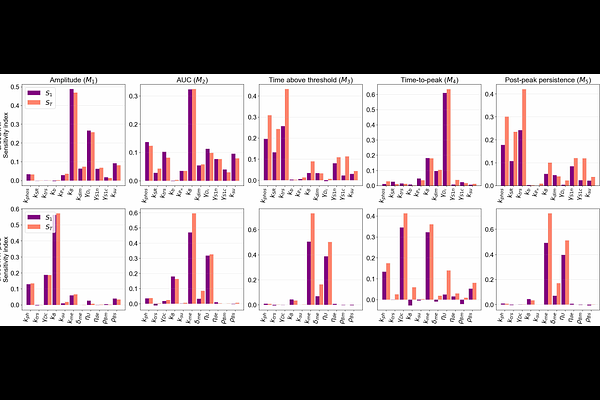
AbstractViral infection can coactivate interferon (IFN)--JAK/STAT1 signalling and the p53--Mdm2 stress-response pathway, two modules that jointly shape antiviral defence and cell-fate decisions. Here, we focus on viral infection contexts capable of inducing genotoxic stress associated with DNA double-strand breaks, thereby triggering oscillatory or sustained p53--Mdm2 dynamics. Whether p53 acts merely as a parallel stress pathway, or actively reshapes how an activated JAK/STAT1 response is temporally decoded and functionally routed, remains unclear. We develop a coupled ordinary [ndash]differential-equation model linking an IFN{gamma}centred JAK/STAT1 core, a p53--Mdm2 module, downstream antiviral and apoptotic effectors, and a coarse-grained viral-burden layer, with p53 regulation placed downstream of STAT1 activation. We find that p53 does not simply increase nuclear STAT1 availability; it redistributes the response towards DNA-bound STAT1 persistence, transcriptional memory and STAT1-driven feedback, producing a persistence--recovery trade-off in which prior p53 stress prolongs the transcriptionally active STAT1 state but delays re-inducibility after repeated IFN stimulation. When IFN and p53-associated stress are both driven by viral burden, p53 is not a uniform amplifier of host defence: p53 preactivation strengthens the upstream memory layer, but downstream effectors buffer rather than mirror this priming. The model further separates antiviral-state engagement from realised viral control: strong effector activation does not guarantee suppression of poorly sensitive viral classes, whereas sensitive viral classes can be cleared before apoptosis. The origin of the stimulus also matters: exogenous IFN or p53 stimulation allows us to assess the host's intrinsic response capacity, whereas virus-induced IFN and p53 stress remain coupled to viral persistence. Persistent viral burden thus emerges as the dynamical link between IFN induction, p53 stress-memory, antiviral maintenance, viral control and the choice between JAK/STAT--IRF1-associated, p53-autonomous or dual apoptotic routing.