Epithelial Stem Cell Fate Determines Chemoradiotherapy Response in Rectal Cancer

Epithelial Stem Cell Fate Determines Chemoradiotherapy Response in Rectal Cancer
Li, N.; Ishaqwala, F.; Wright, T. A.; Wilkinson, A.; Vlckova, P.; Trevers, K.; O'Sullivan, R.; Crampsie, S.; Basiarz, E.; Vanderkamp, S.; McCulloch, A. K.; Dobric, A.; Krishnaswamy, S.; Vanhaesebroeck, B.; Glasgow Serial Sampling Consortium, ; Roxburgh, C. S. D.; Hawkins, M.; Tape, C. J.
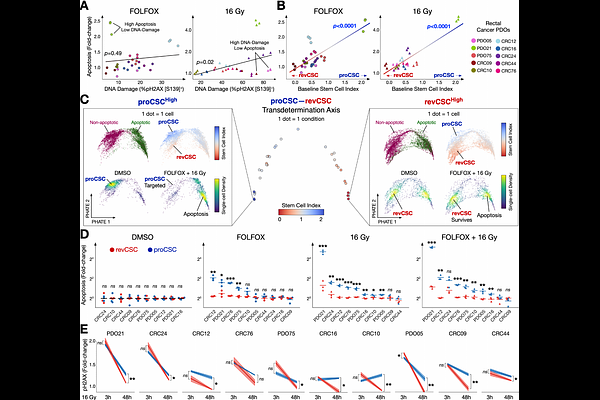
AbstractRectal cancers are often treated with neoadjuvant chemoradiotherapy (CRT), yet 85% of patients do not achieve a pathological complete response. To identify the molecular determinants of CRT response, we profiled the single-cell signalling, DNA-damage, cell-cycle, apoptotic, and cell-fate responses of 2,769 patient-derived organoid cultures treated with CRT, cancer-associated fibroblasts (CAFs), and signal-rewiring agents. We find that CRT response is determined by stem cell-fate. CRT triggers comparable DNA-damage in isogenic proliferative (proCSC) and revival (revCSC) colonic stem cells, but proCSC retain damage and die whereas revCSC resolve damage and persist. Both CRT and CAFs drive proCSC to a common treatment-resistant revCSC fate and high revCSC predicts worse survival in patients. Pharmacologically constraining stem-cell plasticity increases CRT sensitivity, and Spatial Perturbation of ARrayed Tumour Assembloids (SPARTA) confirms YAP/TEAD inhibition improves chemotherapy responses in human stromal-tumour models. These results suggest that cancer cell-fate, not genotoxic damage itself, ultimately governs response to standard-of-care chemoradiotherapy.