Mathematical modeling and sensitivity analysis of synNotch-CAR T-cells identify engineering targets for dynamic tunability

Mathematical modeling and sensitivity analysis of synNotch-CAR T-cells identify engineering targets for dynamic tunability
Diefes, A. J.; Sbaiti, B.; Ciocanel, M.-V.; Kim, C. M.
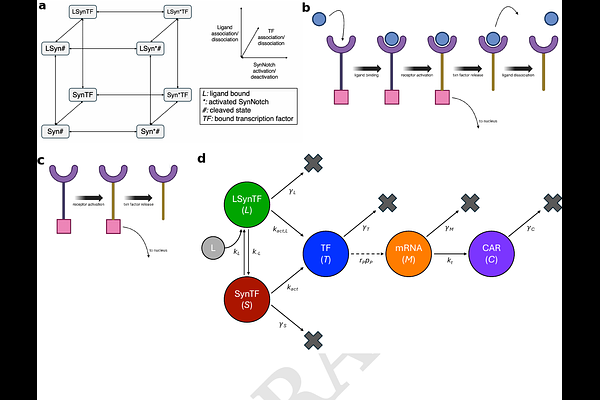
AbstractCancer therapeutics are increasingly incorporating engineered receptors due to their ability to detect extracellular ligands and initiate intracellular responses that regulate gene expression. By redesigning these natural signaling systems, synthetic receptors hold great potential for use in novel cell-based therapies. One particularly promising direction is modifying the Notch receptor, a transmembrane protein that naturally mediates ligand-dependent signaling at the cell surface to regulate cell proliferation and differentiation in neurogenesis. Both the intracellular and extracellular domains of Notch can be replaced with alternative domains, creating the family of modified Notch receptors known as synthetic Notch (synNotch). In existing synNotch-activated chimeric antigen receptor (CAR) T-cells, the extracellular domain can be engineered to adjust binding affinity for a specific cancer antigen, enabling precise tuning of therapeutic activity while minimizing off-target effects. To quantify and inform such tuning, we develop differential equations models of synNotch receptor signaling and subsequent gene expression. The mathematical models couple activation dynamics on fast timescales (characteristic of receptor-ligand interactions) and on slow timescales (characteristic of downstream gene expression dynamics). Global Sobol sensitivity analysis of the proposed models highlights parameters that yield the greatest variability in synNotch signal transduction and gene expression, indicating their potential to be engineered for different functions in future cancer therapeutics. For the receptor-ligand interactions in the synNotch model, we find that ligand association and ligand-independent activation are the most sensitive parameters. In the downstream gene expression model, promoter strength and degradation rates of mRNA and gene product are found to be most amenable to engineering.