A developmental chimera: co-option of appendage, secretory and myogenic programs underlies spider venom gland evolution

A developmental chimera: co-option of appendage, secretory and myogenic programs underlies spider venom gland evolution
Zancolli, G.; Hassan, A.; McGregor, A. P.; Moran, Y.; Robinson-Rechavi, M.
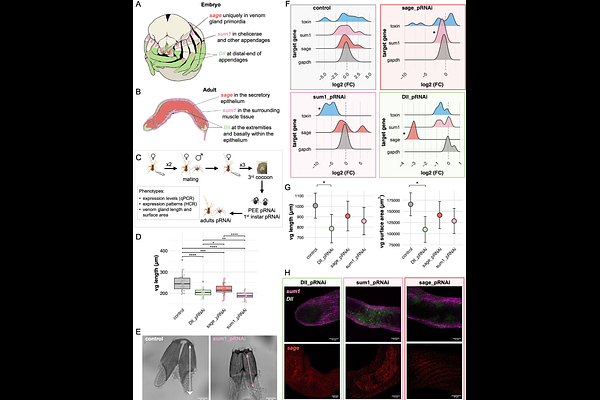
AbstractThe evolutionary emergence of complex organs requires the integration of distinct developmental modules, yet the mechanisms bridging divergent tissue programs into unified functional units remain poorly understood. Animal venom systems, combining high-output secretory epithelia with muscular delivery systems, a provide an exceptional model for studying this modular integration. Here, we show that the venom gland of the spider Parasteatoda tepidariorum is a developmental chimera built by the hierarchical co-option of three ancestral programs. The appendage-patterning gene Distal-less establishes the primary spatial coordinate system for gland development. Downstream, the transcription factor sage maintains secretory epithelium identity; its loss causes downregulation of key venom-processing enzymes and triggers a dramatic phenotypic reversion to a neuronal state. This neural upregulation, accompanied by the downregulation of Notch ligands (delta and jagged), reveals that sage actively represses a latent neural program to maintain secretory fate. Crucially, the myogenic factor sum-1 governs the surrounding muscle layer to drive paracrine crosstalk (Wnt) and sustain lipid metabolism. Knockdown of sum-1 downregulates wntless and fatty acid anabolism genes, alongside the abnormal accumulation of lipid droplets in the secretory epithelium. Ultimately, our findings demonstrate how a complex organ is assembled by fusing an appendicular address, a repressed neuroglandular program, and a myogenic metabolic driver. This modular architecture illustrates a fundamental principle in evolutionary developmental biology: novelty can arise by harnessing the physiological and metabolic capacities of adjacent tissues to fuel the physiological demands of a newly emerged organ.