Density-dependent facilitation of livestock by small mammal ecosystem engineers

Density-dependent facilitation of livestock by small mammal ecosystem engineers
Zhong, Z.; Ni, B.; Lawton, D.; Li, X.; Zheng, X.; Zhou, H.; Su, J.; Li, W.; Hou, F.; Guo, Z.; Dong, Q.; Dong, S.; Dickman, C.; Svenning, J.-C.; Gao, Y.; Zhang, Z.
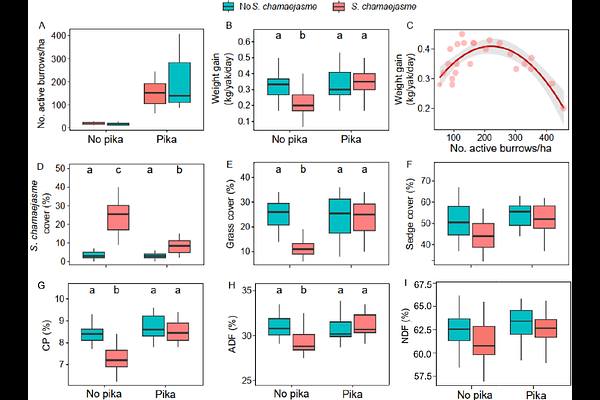
AbstractSmall mammals and large herbivores have co-evolved in grasslands for millions of years, yet how they interplay remains unclear. On the Qinghai-Tibetan Plateau, plateau pikas (Ochotona curzoniae) are often considered pests that compete with livestock at high densities. Using field experiments, we show that pikas facilitate yaks (Bos grunniens) below a moderate density threshold (~200 active burrows/ha). By selectively clipping tall poisonous forbs, especially Stellera chamaejasme, pikas reduced their cover by two-thirds, increased the abundance and protein content of palatable grasses and sedges, improved yak foraging efficiency, and enhanced weight gain by up to 67%. These results provide the first empirical evidence of a density-dependent transition from antagonism to facilitation between small and large herbivores. They highlight how moderate populations of ecosystem-engineering small mammals can sustain both biodiversity and pastoral productivity in rangelands.