Oxygen-sensing regulatory architecture structures mammalian diversification

Oxygen-sensing regulatory architecture structures mammalian diversification
Smaers, J. B.; Gil-Gomez, A.; Rickaby, R. E.; Pugh, C. W.; West, C.; Aggarwal, P.; Hecker, A.; Chen, A.; Wen, C.; Riessland, M.; Rest, J.
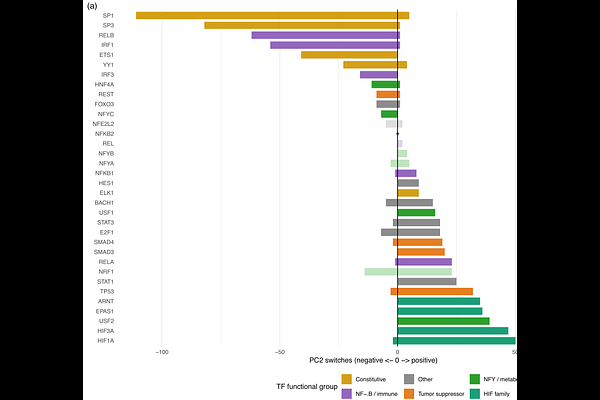
AbstractThe HIF oxygen-sensing pathway traces to the last metazoan common ancestor ~800 million years ago and is conventionally viewed as a conserved cellular stress-response module. Whether this ancestral system has contributed to mammalian diversification at macroevolutionary timescales remains unexplored. We analyzed sequence-encoded TF-gene regulatory architecture for 34 transcription factors and 705 genes in 10 oxygen-sensing pathways across 239 mammalian species. Oxygen-sensing regulatory architecture carries strong clade-structured evolutionary signal. The primary axis of variation tracks a fast-slow life history gradient, marked by rewiring of growth-control and tumor suppressor hub genes. A second axis recovers the monotreme-marsupial-placental transition and aligns with the decline in atmospheric O2 from the Permo-Carboniferous maximum toward present-day levels1. Orthogonal axes encode distinct ecological regulatory strategies; two later axes separately resolve HIF-compatible binding-site architecture and dominant TF-family assignment, identifying regulatory strategies associated with powered flight and hibernation. This multidimensional space also informs Peto's paradox, suggesting that relative cancer resistance tracks the combination of tumor-suppressor enrichment and coordinated HIF-complex assignment. Together, these results indicate that regulatory configurations arise at major evolutionary transitions and persist coherently across descendant lineages through a punctuated mode of regulatory evolution, providing genomic-level evidence for Simpson's adaptive zones and a mechanism for evolutionary stasis. These findings reframe oxygen sensing as a regulatory hub in mammalian diversification, with stable patterns of TF-family assignment configurations emerging as a structuring force in macroevolution.