Quantification of Phytohormones in Plants - Optimized Extraction, Separation and Detection

Quantification of Phytohormones in Plants - Optimized Extraction, Separation and Detection
Wewer, V.; Dyballa-Rukes, N.; Metzger, S.
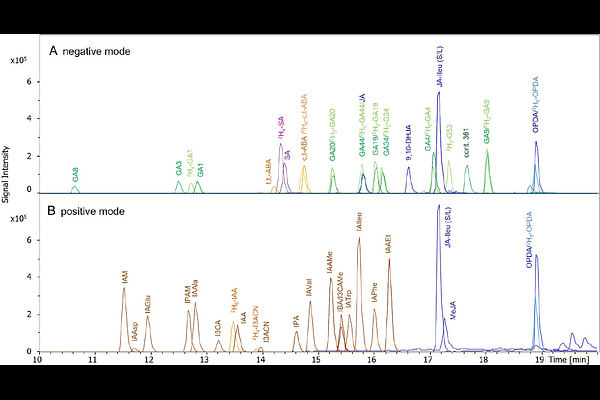
AbstractPhytohormones are key players in the regulation of plant development and metabolism. The different phytohormone classes comprise numerous chemically very diverse compounds, which are often present at very low concentrations. The chemical properties of phytohormones range from acidic to basic and from polar to non-polar. Furthermore, concentration varies strongly among different phytohormones, between plant species, tissues and developmental stages. Challenges often arise when only small amounts of plant material are available and when plant species are investigated in which the phytohormone profile has not yet been characterized. To establish a method for comprehensive phytohormone analysis we addressed these challenges by choosing and optimizing a suitable extraction method followed by optimized HPLC separation. We compared the most widely-used mass spectrometric detection methods, multiple reaction monitoring (MRM) on a triple quad instrument with high-resolution mass spectrometry (HRMS) on a Q-TOF instrument, and discuss the advantages of both methods and their limitations. - We compared various methods described in literature for the extraction of six phytohormone classes by liquid-liquid extraction and solid phase extraction purification and describe our optimizations to the selected method. - We optimized HPLC separation for 50 different phytohormones. - We evaluated the application of MRM and HRMS detection strategies.