Magic traits, search costs, and the persistence of species in secondary contact

Magic traits, search costs, and the persistence of species in secondary contact
Farley, J. R.; Irwin, D.
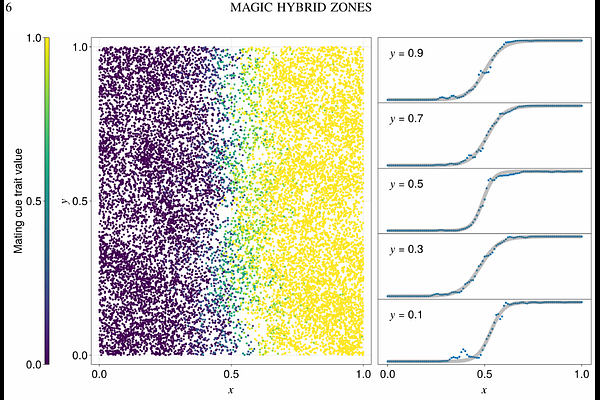
AbstractWhen two populations come into secondary contact, assortative mating can act as a barrier to gene flow. However, when assortative mating is incomplete, associations between preference and cue loci can break down, eroding assortative mating and collapsing species boundaries. Here, we investigate factors that can contribute to the maintenance of differentiated reproductive populations despite gene flow, resulting in either clinal hybrid zones or overlap zones between distinct populations. By simulating secondary contact on a uniform two-dimensional landscape using an individual-based computer model, we examine how the potential outcomes of secondary contact depend on search costs and/or pleiotropy between various combinations of mating cue, mating preference, and hybrid viability traits. We find that search costs can maintain stable mating trait clines, even in the absence of hybrid inviability traits. Pleiotropy between mating cues and hybrid inviability (i.e., ``magic cues") temporarily stabilizes the mating cue cline but fails to maintain mating preference differentiation, since preference is not itself under direct selection. As the preference cline collapses, assortative mating breaks down, and --- absent search costs or very strong hybrid inviability --- the mating cue cline subsequently collapses as well. Thus, without preference-cue or preference-viability pleiotropy, search costs are essential for maintaining mating trait differentiation. Changes to the genetic architecture of mating traits strongly alter the distribution of phenotypes, affecting whether parental populations can coexist spatially. Small parameter changes can abruptly shift outcomes, highlighting the sensitivity of these systems.