Representative vs. Load-bearing Layers: A Dissociation in Genomic Foundation Models

Representative vs. Load-bearing Layers: A Dissociation in Genomic Foundation Models
Cho, Y.; Kim, M. S.; Kim, S.
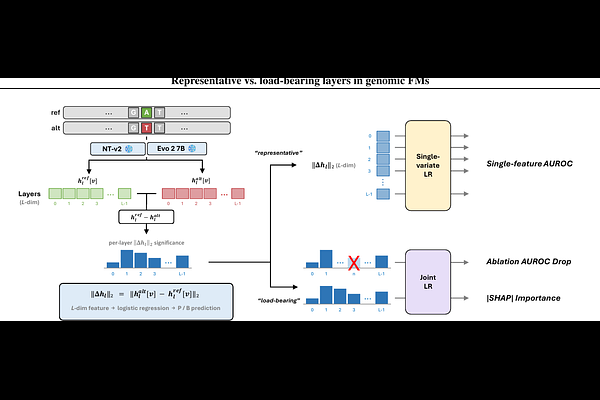
AbstractDownstream use of genomic foundation models follows one of three conventions: aggregating representations across all layers (Pearce et al., 2026), defaulting to the last hidden state as a fixed feature extractor (Dalla-Torre et al., 2024), or picking a single intermediate layer via mechanistic-interpretability tooling (Brixi et al., 2026). None of these examines which layer a joint classifier actually relies on. We probe this question with a minimal training-free scalar, ||{triangleup}h{ell}||2, defined as the L2 norm of the per-layer hidden-state shift at the variant token. We evaluate it on 8,008 ClinVar (Landrum et al., 2018) single-nucleotide variants in NT-v2 500M (Dalla-Torre et al., 2024), a masked language model (MLM), and Evo 2 7B (Brixi et al., 2026), a causal language model (CLM) with a hyena/attention hybrid. In both models, the layer with peak single-feature AUROC (the representative layer) is not the layer a joint multi-layer classifier most depends on (the load-bearing layer, identified by leave-one-layer-out ablation drop and concordant with |SHAP| (Lundberg & Lee, 2017)). Representative layers sit mid-network in both models, whereas load-bearing depth lies at opposite ends of the depth axis: mid-shallow in the MLM and deep in the CLM hybrid. The dissociation has direct downstream consequences. In NT-v2, a 1-dimensional mid-layer scalar exceeds the canonical 1024-dimensional last-layer mean-pool baseline by +0.049 AUROC. In Evo 2, the 4096-dimensional mean-pool is competitive with the joint ||{triangleup}h{ell}||2 feature, so standard last-layer pooling leaves variant-relevant signal untapped specifically in MLM-based pipelines.