Molecular Basis of Behavioral Diversity in a Sibling Species Trio

Molecular Basis of Behavioral Diversity in a Sibling Species Trio
Chai, C. M.
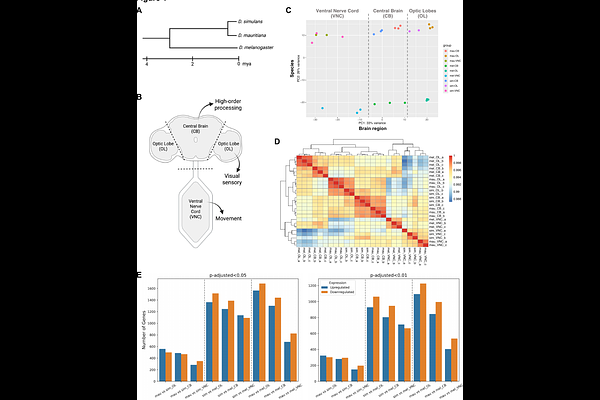
AbstractThe brain is the main controller of animal behaviors. During the speciation process, divergent behaviors can arise between new sibling species. However, the comprehensive molecular changes in the brain that give rise to these emergent behavioral differences are not well understood. Here, I present a comparative analysis of brain region-specific gene expression between a trio of closely-related Drosophila sibling species representing two consecutive speciation events. My analysis revealed strongest patterns of molecular conservation across speciation events in the brain region that executes movement, while the visual sensory system tends to be most divergent in gene expression. I also introduce a novel locomotor activity difference between sibling species, and demonstrate how set theory can be applied in the context of my experimental design to constrain the number of candidate neuronal genes underlying behavioral diversification for further detailed investigation. As genomic resources expand (1), iteratively exploring these patterns across ever larger swaths of animal phylogeny is poised to reveal general principles of brain functional molecular evolution.