Identifying Novel Targets of the Stringent Response in Plants and Cyanobacteria using chemoproteomics

Identifying Novel Targets of the Stringent Response in Plants and Cyanobacteria using chemoproteomics
Karlsson, A.; Rillema, R.; Sporre, E.; Englund, E.; Vogiatzi, N.; Llavina Ramirez, J.; Gurdap, C. O.; Sezgin, E.; Edfors, F.; Blikstad, C.; Strand, A.; Ducat, D. C.; Hudson, E. P.
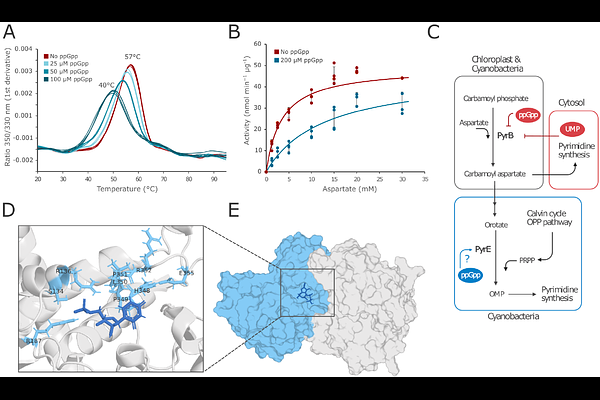
AbstractSurvival in dynamic environments requires photosynthetic organisms to rapidly sense and respond to stress. The stringent response, mediated by the signaling molecule guanosine-3,5-bisdiphosphate (ppGpp), is crucial for acclimation to environmental changes such as darkness and nitrogen limitation. While it has been extensively characterized in heterotrophic bacteria such as Escherichia coli, the molecular mechanisms and regulatory targets of ppGpp in photosynthetic organisms remain less understood. Here, we report large-scale chemoproteomic identification of ppGpp-binding proteins across plant chloroplasts and cyanobacteria, revealing both conserved and novel targets compared to E. coli. In plants, we found that ppGpp regulates pyrimidine metabolism by inhibiting the chloroplastic enzyme aspartate transcarbamoylase (PyrB). In cyanobacteria, we found that ppGpp activates glucose-1-phosphate adenylyltransferase (GlgC) involved in glycogen synthesis, activates citrate synthase (GltA), and induces carboxysome aggregation. These findings expand the known ppGpp regulatory network in photosynthetic organisms and provide a foundation for understanding how ppGpp coordinates adaptation to nutrient and environmental stresses.