Humans as predator of the biosphere: technological modulation of consumer/resource dynamics and its implications for sustainability

Humans as predator of the biosphere: technological modulation of consumer/resource dynamics and its implications for sustainability
Weinberger, V. P.; Zalaquett, N.; Lima, M.
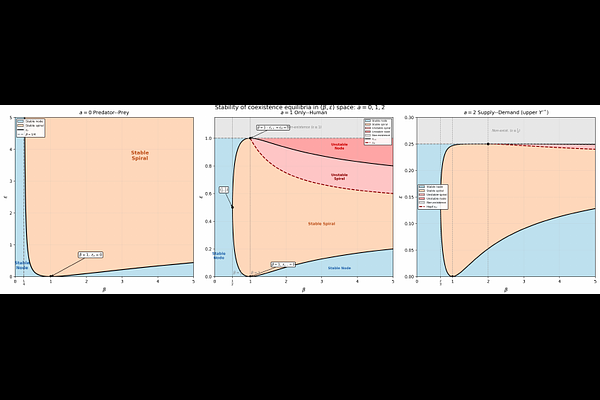
AbstractHumans are just another species on Earth, but modern telecoupled societies and their socioeconomies impose immense consumption demands on the biosphere, detaching from common ecological rules. Starting from a simple ecological consumer/resource model, with humans as the consumers and terrestrial organic carbon (i.e., the biosphere) as the resource, we assume that technology modulates both human carrying capacity, {nu}0 , and the rate of biosphere consumption, 0 . Three different functional-relation scenarios were tested, modulated by parameter a. In all three scenarios, equilibria and stability directly depended on the relative role that technology played in the model parameters, or the compound technological impact ({epsilon} {equiv} 0 {nu}0). Moreover, two of the three scenarios showed Hopf bifurcations and regions with no equilibrium. The models were parameterized and fitted to actual data using a trajectory of more than 150 years. These analyses suggest that we are currently in a stable oscillatory spiral with no immediate Hopf bifurcation threat, but within a trajectory that continuously depletes the biosphere and approaches a collapse in human population size if no changes are made in the relationship that technology has with growth (i.e., {nu}0 ) versus consumption (i.e., 0 ) dynamics. Because our predatory dynamics also appear to have shifted from regular predator/prey dynamics toward a supply/demand scenario, with persistently increasing values, the threat of a Hopf bifurcation is now present in our trajectory: changes in the stability of the coexistence equilibrium may arise. This simple model warns that we must pay closer attention to the predatory relations that our technologies are creating with biosphere dynamics, in a way that goes beyond population numbers and technological development alone.