Multistage Machine Learning Reveals Circadian Gene Programs and Supports a Retina-Choroid Axis in Myopia Development

Multistage Machine Learning Reveals Circadian Gene Programs and Supports a Retina-Choroid Axis in Myopia Development
Watcharapalakorn, A.; Poyomtip, T.; Tawonkasiwattanakun, P.; Dewi, P. K. K.; Thomrongsuwannakij, T.; Mahawan, T.
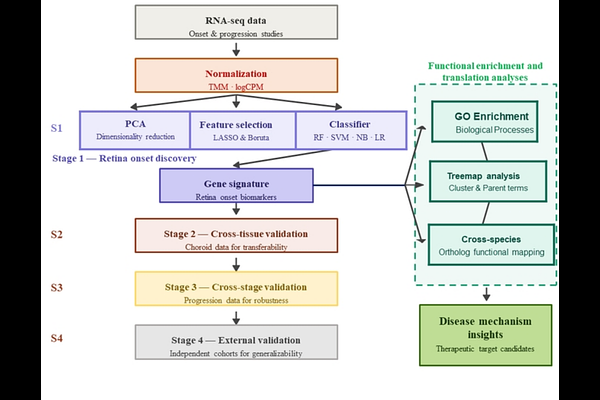
AbstractPurpose To determine whether circadian timing defines critical molecular windows in myopia development and to assess the transferability of circadian gene programs across ocular tissues, disease stages, and species. Methods Publicly available retinal and choroidal RNA-seq datasets from chick models of form-deprivation myopia were analyzed using unsupervised transcriptomic profiling and multistage machine-learning classification. Circadian windows were defined based on Zeitgeber time, and samples were grouped accordingly for downstream analyses. Classification model robustness was evaluated through cross-tissue and cross-stage validation and further assessed using external validation in an independent dataset. Functional translation to humans was examined using ortholog-based Gene Ontology enrichment analysis to identify conserved biological processes and higher-order regulatory pathways. Results A circadian critical window at ZT8-ZT12 exhibited the strongest transcriptional divergence during both myopia onset and progression. Gene signatures derived from this window generalized across retina and choroid and remained predictive across disease stages, supporting coordinated molecular regulation between ocular tissues. External validation confirmed the reproducibility of these signatures despite differences in experimental design and gene coverage. Functional mapping revealed that conserved molecular components in chicks are reorganized into more complex neuroendocrine and regulatory networks in humans, indicating cross-species conservation with increased functional complexity. Conclusions Circadian timing strongly shapes myopia-related gene expression and underlies coordinated retina-choroid signaling. These findings highlight circadian biology as a key factor of refractive development and suggest that time-dependent mechanisms may influence myopia susceptibility, progression, and response to treatment.