LOCOM2: Robust Differential Abundance Analysis for Microbiome Data

LOCOM2: Robust Differential Abundance Analysis for Microbiome Data
He, M.; Satten, G. A.; Hu, Y.-J.
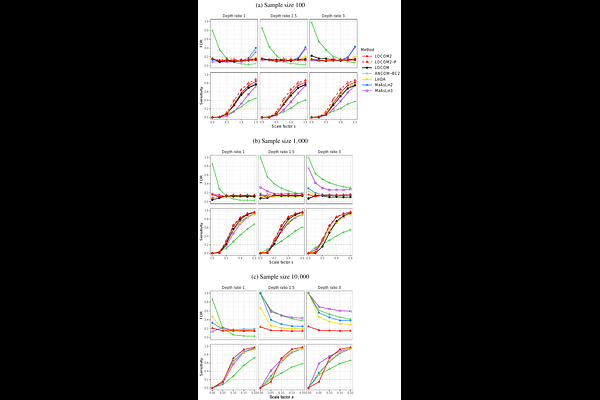
AbstractBackground: Numerous methods have been developed for differential abundance analysis of microbiome data; however, many fail to adequately control error rates, contributing to the reproducibility crisis in microbiome research. Moreover, new challenges have emerged, including large-scale studies, differential library size distributions, unbalanced case-control designs, and the increasing availability of only relative-abundance data rather than read counts. Methods: We propose LOCOM2 to address these challenges. The method refines the weighting scheme in LOCOM to eliminate confounding by library size while accommodating relative abundance data. It incorporates a series of adjustments to ensure stable and reliable estimation, even under extreme conditions such as very rare taxa and highly unbalanced case-control designs. In addition, LOCOM2 replaces the computationally intensive permutation procedure in LOCOM with a Wald-type test, substantially improving computational efficiency. To evaluate performance, we conducted extensive simulation studies using the MIDASim simulator and three data templates representing diverse body sites. We benchmarked LOCOM2 against state-of-the-art methods, including LOCOM, LinDA, ANCOM-BC2, MaAsLin2, and MaAsLin3. This benchmarking effort provides an essential foundation for the next stage of microbiome research. Results: LOCOM2 achieved accurate control of the false discovery rate across all simulation scenarios, whereas none of the other methods consistently did so. LOCOM2 also demonstrated the highest sensitivity for detecting true signals. Applications of these methods to three real microbiome datasets further corroborated these findings.