Histone modification crosstalk between host and pathogen

Histone modification crosstalk between host and pathogen
Miller, S. S.; Hrit, J.; Rothbart, S. B.; Worden, E. J.
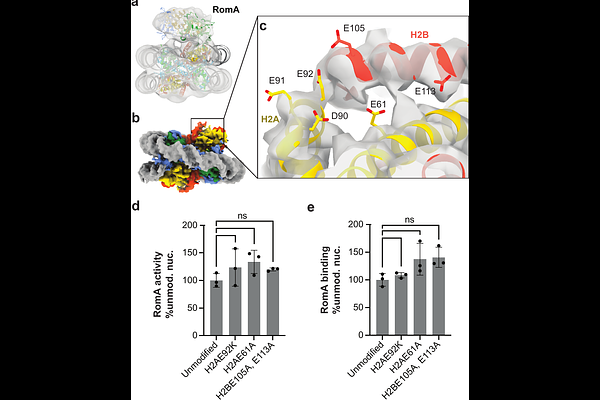
AbstractBacterial pathogens modulate host cell physiology by secreting effector proteins that rewire host signaling pathways. A subset of these effectors directly modify host chromatin to reprogram gene expression and promote infection. While these enzymes are thought to function autonomously, the extent to which the host epigenetic landscape regulates their activity remains largely unknown. RomA and its homolog LegAs4 are Set domain-containing lysine methyltransferases from Legionella pneumophila that methylate histone H3 at lysine 14 (H3K14) to suppress host immune responses and enhance intracellular bacterial replication. Here, we demonstrate that RomA activity is constrained by pre-existing host histone post-translational modifications (PTMs) through multiple layers of histone PTM crosstalk. RomA selectively binds and methylates unmodified histone H3 tails and is inhibited by histone PTMs associated with active transcription, including H3K4 tri-methylation, H3K4 acetylation, and H4K12 mono-methylation. We identify both cis- and trans-histone regulatory mechanisms, whereby unmodified H3K4 and H3K14 must reside on the same H3 tail to support RomA activity, while H4K12me1 inhibits RomA across the nucleosome. Notably, cryo-EM analysis and biochemical data reveal that RomA does not engage the nucleosome acidic patch but instead associates flexibly through histone tails. Together, these findings establish the host epigenetic regulation of bacterial effectors as a fundamental and previously unrecognized layer of host-pathogen interactions.