N-terminal Chirality and Sequence Variations Modulate the Conformational Landscape of Amyloid-beta 42

N-terminal Chirality and Sequence Variations Modulate the Conformational Landscape of Amyloid-beta 42
Zhu, Q.; Yu, H.
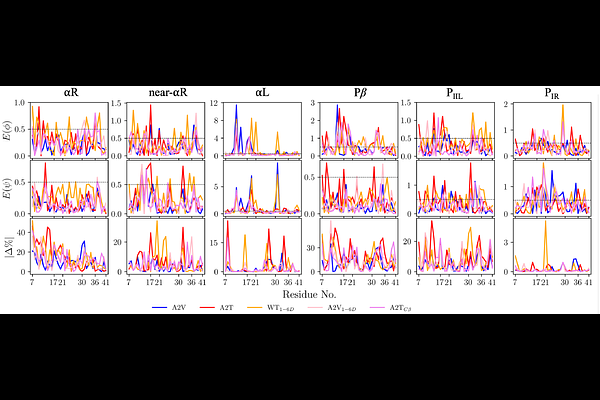
AbstractAmyloid beta (A{beta}), one of the hallmark proteins of Alzheimer's Disease (AD), aggregates into plaques that are strongly linked to cognitive decline and neuronal death. Reducing its aggregation propensity may provide a strategy to slow the progression of AD. While chirality modulation has emerged as an innovative approach to disrupt this process, research has primarily focused on alterations at the C position, often overlooking the impact of the second chiral center, such as the C{beta} atom of Threonine. Furthermore, the underlying mechanisms governing these chiral effects remain elusive. Given the intrinsically disordered nature of the A{beta} peptide, we employed temperature-replica exchange molecular dynamics (T-REMD) simulations to explore its rugged conformational landscape. We considered sequence mutations (A2T, A2V), N-terminal chirality inversion of the first six residues (A2V1-6D and WT1-6D), and alteration of the second chiral center (C{beta}) of Threonine (A2TC{beta}). By analyzing the effect size and population change induced by these mutations and chiral modulation, we concluded that the modulation at the N-termini is not confined locally but also exerts specific effects on the central hydrophobic core (CHC) region. Inspection of their free energy landscape and representative structures reveals that the protective or pathogenic effects of these variants correlate with their similarity to the wild type (WT) ensemble. Beyond these static thermodynamics analyses, a direct connection to phase transitions was made by estimating heat capacity as a function of temperature. Both analyses predict that A2TC{beta} may exert a pathogenic effect, in contrast to the protective nature of A2T. These findings offer a deeper understanding of the effects of site-specific mutations and chirality and shed light on the development of advanced therapeutic strategies for AD.