The Hindu Kush, not the Indus Valley, divides amphibian biogeographic realms

The Hindu Kush, not the Indus Valley, divides amphibian biogeographic realms
Jablonski, D.; Rasekh, M.; Zia, A.; Irfan, M. A.; Khalili, F.; Wahaj, N. M.; Noori, B.; Osmani, A. R.; Stanekzai, N. S.; Masroor, R.; Dufresnes, C.
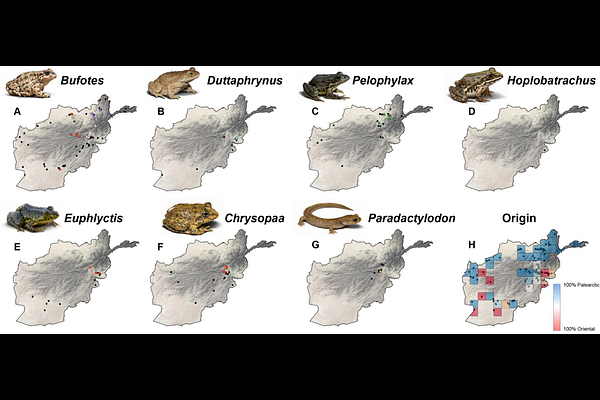
AbstractThe boundary between the Palearctic and Oriental biogeographic realms is one of the oldest unresolved problems in Eurasian biogeography. In Central and South Asia, this transition is remarkable and has often been linked to the Indus River Valley, yet the role of adjacent mountain systems and arid landscapes has remained largely untested because critical regions, especially Afghanistan, have been chronically under-sampled due to difficult, long-term socio-political situation. Here we use a unique amphibian material from Afghanistan and adjacent northwestern Pakistan to test whether the Hindu Kush marks the effective boundary between these two realms. Combining molecular barcoding across all seven amphibian genera inhabiting the region with updated distribution records, we find a strikingly consistent lineage turnover centered on the eastern Hindu Kush and adjacent arid systems. Palearctic taxa reach their southeastern limits along the massif, whereas Oriental taxa extend only to its southern foothills. By contrast, Oriental lineages cross the Indus River without detectable phylogeographic break, indicating that the river valley does not function as a major biogeographic boundary for the taxa examined. The Hindu Kush also harbors endemic relict taxa of both Palearctic and Oriental affinities, revealing a dual role as both refugium and dispersal barrier. Thus, our results identify the Hindu Kush as the de facto boundary between the Palearctic and Oriental realms in this part of Eurasia and show that under-sampled arid-montane regions can disproportionately improve global biogeographic frameworks.