An introgressed haplotype decouples phenotype from genome-wide ancestry

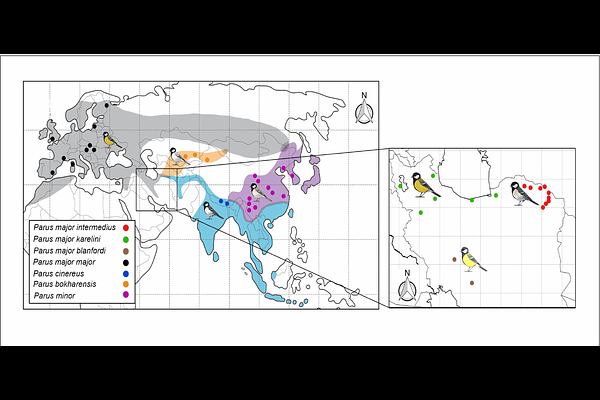
An introgressed haplotype decouples phenotype from genome-wide ancestry
Javaheri Tehrani, S.; Chen, Y.-C.; van Oers, K.; Bosse, M.; Paeckert, M.; Martens, J.; Aliabadian, M.; Alaei Kakhki, N.; Gossmann, T.
AbstractIntrogression redistributes genetic variation among diverging lineages, shaping evolutionary trajectories and contributing to phenotypic evolution. Yet how localized introgressed genomic regions persist despite extensive genomic homogenization remains poorly understood. Here, we investigate the evolutionary history of the northeastern Iranian great tit (\textit{Parus major intermedius}), a grey-plumaged member of the great tit complex occurring at the eastern range margin of the green- and yellow-plumaged \textit{major} lineage, adjacent to the grey-plumaged Central Asian \textit{bokharensis} lineage, and long regarded as a putative hybrid. We find that \textit{P.~m.~intermedius} retains predominantly \textit{major}-derived genomic ancestry despite its grey plumage, revealing extensive genomic homogenization across the genome. Surprisingly, a single localized introgressed haplotype on chromosome~24 retains \textit{bokharensis}-derived ancestry, exhibits elevated genomic differentiation relative to the genomic background, and overlaps the carotenoid-processing gene \textit{BCO2}, a strong candidate underlying plumage pigmentation. Our findings provide a genomic explanation for the discordance between phenotype and genome-wide ancestry, demonstrating how localized introgression can preserve genomic regions associated with phenotypic divergence despite extensive genomic homogenization. This system illustrates how individual genomic regions can retain distinct evolutionary histories long after the surrounding genome has largely homogenized.