miR-100-5p modulates postprandial triglyceride response by targeting PCSK9

miR-100-5p modulates postprandial triglyceride response by targeting PCSK9
VANDUYSE, A.; MOTTE, A.; NEVES, C.; DACLAT, R.; GALIER, S.; BLUTEAU, O.; MATERNE, C.; FRISDAL, E.; DURAND, H.; GIRAL, P.; SALEM, J.-E.; LACORTE, J.-M.; RESIST-PP Consortium, ; LE MAY, C.; LE GOFF, W.; LESNIK, P.; GUERIN, M.
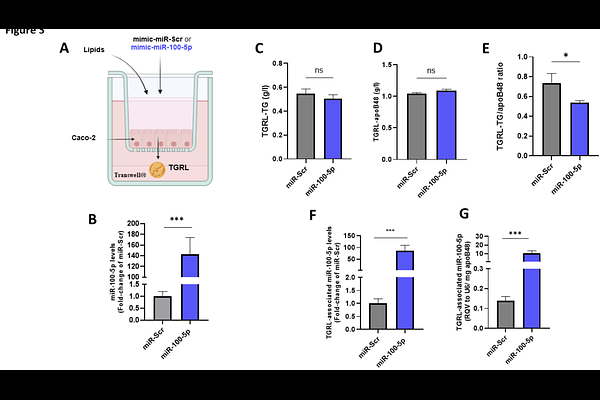
AbstractBackground: Elevated postprandial hypertriglyceridemia (PP-HTG) is a significant risk factor for development of cardiovascular diseases, however, the mechanisms underlying its exaggerated rise remains poorly understood. MicroRNAs (miRs) are known to be implicated in the regulation of lipid metabolism, thus identifying them as potential key players. We presently investigated whether miRs may control postprandial triglyceride (PP-TG) response. Methods: Postprandial changes in circulating miR expression as a function of the degree of postprandial TG response were evaluated in non-dyslipidemic healthy subjects (n=32). The impact of miR-100-5p on hepatic gene expression was evaluated in differentiated Caco2 and HepG2 cells by analysis of hepatic transcriptome (RNAseq), western blot and ELISA. In vivo studies were conducted in C57BL/6J mice overexpressing mimic miR-100-5p. Results: Postprandial variation in circ-miR-100-5p levels inversely correlate with PP-TG response. Cir-miR-100-5p was preferentially associated with TGRL particles of intestinal origin in subjects exhibited a low PP TG response. Differential analysis of transcriptome from HepG2 cells transfected by either mimic miR-100-5p or scrambled mimic miR as control allowed us to identify PCSK9 as a down-regulated gene. Overexpression of miR-100-5p in HepG2 cells significantly decreased PCSK9 mRNA levels by 52% (p<0.0001), cellular protein content by 28 % (p<0.0001) as well as PCSK9 secretion by 39% (p<0.0001). In vivo systemic delivery of mimic miR-100-5p induced a two-fold reduction (p<0.0001) on PP-TG in mice, such effect being abolished by blocking the circulating form of PCSK9 with alirocumab. Finally, we revealed a significant inverse relationship between circulating miR-100-5p expression levels and both PCSK9 levels and the magnitude of postprandial hypertriglyceridemia. Conclusion: Taken together, our observations reveal that miR-100-5p regulates postprandial hypertriglyceridemia by targeting PCSK9, thus enhancing hepatic triglyceride-rich lipoproteins (TGRL) uptake. Our findings allow us to propose circ-miR-100-5p as a potential biomarker for early identification of subjects at high cardiovascular risk, prior to appearance of classical clinical features of metabolic disorders.