Visual - Acoustic Thigmotaxis in Zebrafish Larvae: A High throughput NAM for Neurotoxicity Assessment

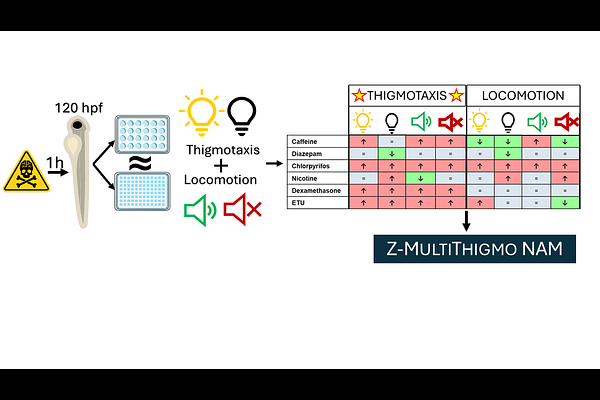
Visual - Acoustic Thigmotaxis in Zebrafish Larvae: A High throughput NAM for Neurotoxicity Assessment
Torres-Ruiz, M.; Munoz Palencia, M.; De La Vieja, A.; Canas Portilla, A. I.
AbstractThe nervous system is highly vulnerable to chemical disruption, yet current regulatory guidelines do not include behavioral endpoints that capture changes in stress-related responses. Zebrafish larvae, up to 5 days old, have emerged as a promising model to bridge this gap, offering genetic and neurochemical similarity to humans together with high throughput potential. In this work, we have developed and evaluated a larval thigmotaxis assay as a new approach methodology (NAM) to detect behavioral alterations caused by neuroactive substances. Thigmotaxis, or edge-preference behavior, was studied in zebrafish larvae exposed to a range of model compounds and challenged with both visual (light/dark) and acoustic (sound/silence) stimuli. We compared 24 round well plates, commonly used in behavioral assays, with 96 square well plates to increase throughput. The two formats showed equivalent results, supporting the use of the higher capacity system. Classical controls confirmed assay performance with caffeine increasing thigmotaxis, while diazepam decreased it. Additional neuroactive substances with diverse modes of action (chlorpyrifos, nicotine, dexamethasone, ethylenethiourea) produced stimulus-dependent responses, whereas negative controls (saccharin, amoxicillin) had little or no effect. Benchmark dose modeling showed that thigmotaxis was generally more sensitive than traditional locomotor activity endpoints. Overall, this multiplexed visual-acoustic thigmotaxis assay proved reproducible, scalable, and sensitive. In neurotoxicity testing this method could be used both as a stand-alone assay or as part of a broader behavioral NAM battery to assess potential effects on the vertebrate nervous system. This method provides a practical and ethical tool to improve chemical safety assessment both in ecotoxicology and human toxicology.