A portable orthogonal replication system enables continuous gene evolution near the biological speed limit

A portable orthogonal replication system enables continuous gene evolution near the biological speed limit
Tian, R.; Rehm, F. B. H.; Kenneth, M.; Jamali, K.; Zhotev, P. S.; Liu, K. C.; Chin, J. W.
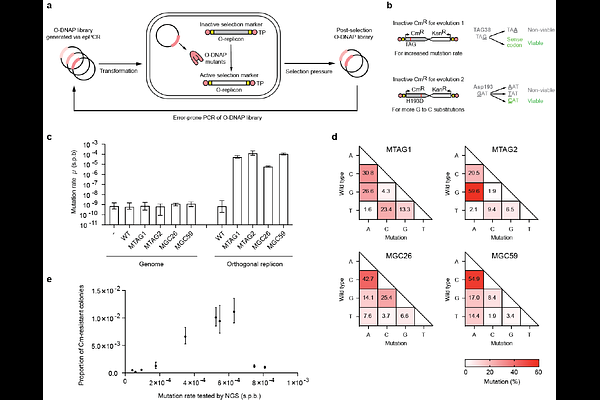
AbstractOrthogonal DNA replication systems uncouple the mutagenesis of target genes from host viability, enabling target gene hypermutation beyond the genomic critical error threshold and thereby unlocking access to greater sequence space for accelerated evolution. Here we introduce a series of upgrades to the E. coli orthogonal replication system, EcORep. We develop strategies to efficiently establish, engineer, and transform orthogonal replicons. We develop and utilize replicon-REXER to establish a 77 kb replicon, the largest orthogonal replicon reported to date. Directed evolution of the orthogonal DNA polymerase yielded variants with mutation rates of ~10-4 substitutions per base per generation and best-in-class mutational spectra. These polymerases are three orders of magnitude more mutagenic than the first-generation EcORep system, enable mutagenesis at one million times the genomic levels, and straddle the evolutionary critical error threshold for the mutation of genes tested. Using the highly mutagenic EcORep system, we rapidly evolve an ethanol assimilation pathway for increased performance. Furthermore, we find that the three components sufficient to drive the minimal EcORep system enable O-replication systems to be established in other Gram-negative bacteria. Thus, we establish VinORep in Vibrio natriegens. VinORep combines O-replicon mutation, around the limit for molecular evolution of genes, with the fastest growing organism, to realize gene evolution approaching the biological speed limit. We exemplify the utility of this advance through the rapid evolution of new function - via the accumulation of tens of mutations, and selection - in 16 hours.