Taxon-specific differences in C and N cycling and metabolic activity of intertidal organisms: Part A - Short-term processes

Taxon-specific differences in C and N cycling and metabolic activity of intertidal organisms: Part A - Short-term processes
Stratmann, T.; van Oevelen, D.; van der Meer, M. T.
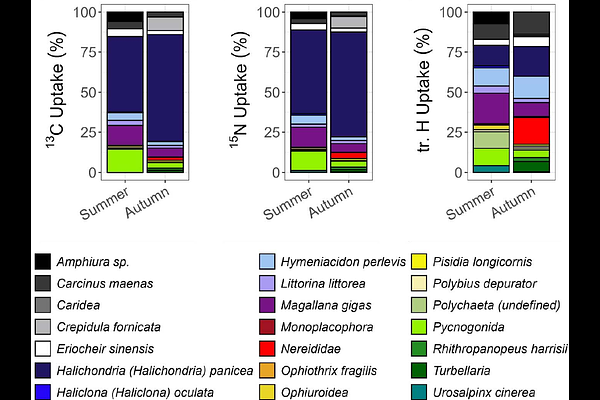
AbstractEuropean tidal flats that host non-native Magallana gigas reefs contribute to several ecosystem functions. Among others, they provide a habitat for a large variety of associated fauna. However, we often lack detailed information about any trophic interactions of the associated macrozoobenthos species with the oysters, and about their role in the carbon and nutrient cycle. Therefore, we performed ex-situ pulse-chase tracer experiments in the Eastern Scheldt (Southwest Dutch Delta, Netherlands) in summer and autumn 2020, where we fed M. gigas and their associated fauna 13C- and 15N-enriched bacterioplankton while the macrozoobenthos was incubated in water containing deuterium oxide (2H2O; enrichment: 1 - 2.5%). The aim was (1) to assess differences in short-term (<12h) processing of bacterioplankton in summer and autumn, and (2) to study differences in 2H incorporation - a proxy for metabolic activity - of M. gigas and its associated fauna in summer and autumn. In summer, all macrozoobenthos species combined consumed significantly less bacterioplankton-derived 13C and 15N than in autumn, while all macrozoobenthos species combined incorporated comparable amounts of 2H into their tissue in both seasons. Most bacterioplankton-derived 13C and 15N was taken up by sponges (Halichondria panicea, Hymeniacidon perlevis), crabs (Carcinus maenas, Eriocheir sinensis, Rhithropanopeus harrisii), and limpets (Crepidula fornicata). Most 2H was taken up by crabs (C. maenas, E. sinensis), sponges (H. perlevis), and snails (Littorina littorea), implying that these species were the most metabolically active ones. Overall, the metabolic activity was linked to feeding activity in summer 2020, whereas in autumn 2020, the link was weaker and the most metabolically active species were not necessarily the species that had incorporated most 13C and/ or 15N.