Development of Shelf-Stable Reagents and Assay Kits for Bioluminescence Applications using the Capillary-Assisted Vitrification Platform Stabilization Technology

Development of Shelf-Stable Reagents and Assay Kits for Bioluminescence Applications using the Capillary-Assisted Vitrification Platform Stabilization Technology
Shank-Retzlaff, M.; Radford, S.; Peris-Taverner, Y.; Dibble, M.; Corn, K.; Zhu, T.; Martello, S.; Mayeau, M.; Ladd, A.; Renu, S.; Chunduri, T.; Jadhav, A.; Dart, M.; Rafat, M.; Bronsart, L.
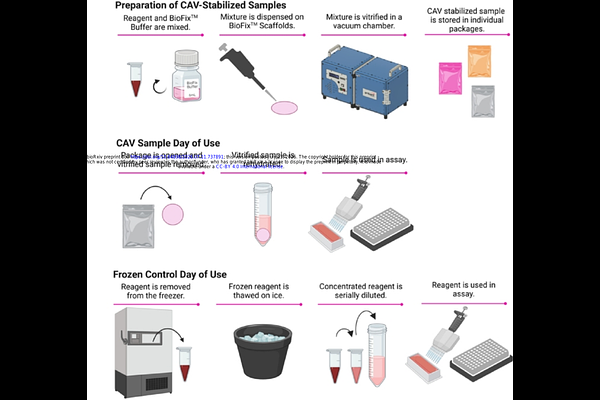
AbstractLuminescence is a powerful method for detecting trace analytes and monitoring biological processes. However, most bioluminescence reagents, including luciferase and its substrates, are sensitive to temperature, limiting their useable shelf lives, and resulting in inconsistent performance. Enhancing the stability of these reagents could improve data quality, simplify workflows, and address cold chain storage issues. In this study, we demonstrate the application of the platform stabilization technology, capillary-assisted vitrification (CAV), as a tool to stabilize different luciferases and their substrates, and the application of the stabilized reagents in both in vitro and in vivo bioluminescent assays. We demonstrate that CAV-stabilized reagents can be stored and shipped ambiently, maintain consistent performance over time, and are suitable for use in cell viability quantification, tumor monitoring, in vivo imaging, microbial detection, and immunoassays. Additionally, different reagents can be co-formulated to make ready-to-use assay kits that can also be shipped and stored ambiently. Our results demonstrate that CAV stabilization is a viable alternative to traditional storage methods, with broad potential to improve bioluminescence workflows.