Overcoming protocatechuate and catechol accumulation in muconic acid production via adaptive laboratory evolution and metabolic engineering in Pseudomonas putida

Overcoming protocatechuate and catechol accumulation in muconic acid production via adaptive laboratory evolution and metabolic engineering in Pseudomonas putida
Bleem, A. C.; Hodges, T. L.; Lind, T. M.; Kuatsjah, E.; Gao, Y.; Gapuz, M. A.; Kellermyer, Z. A.; Benson, A. F.; Ingraham, M. A.; Werner, A. Z.; Kim, Y.-M.; Johnson, C. W.; Beckham, G. T.
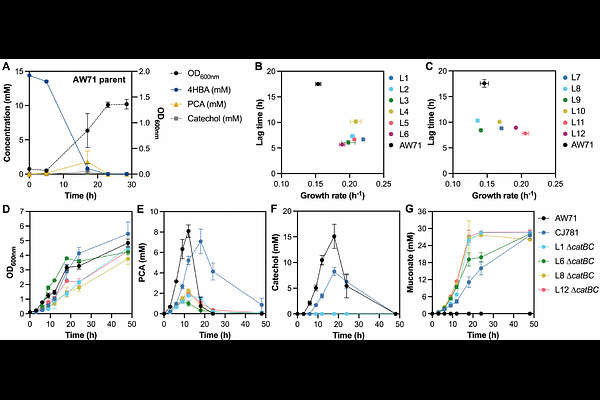
AbstractMuconic acid is an industrially valuable molecule that can be biologically produced from diverse biogenic and waste-derived feedstocks, including sugars and lignin- and plastic-derived aromatic compounds. However, accumulation of protocatechuate (PCA) has been observed in multiple microbes engineered for muconate production when the PCA decarboxylase, AroY, is used. This raises the question of whether PCA decarboxylation represents a rate-limiting step and how this bottleneck might be alleviated, especially given the toxicity and reactivity of PCA and catechol intermediates. To address this, we performed adaptive laboratory evolution (ALE) on a strain of Pseudomonas putida originally engineered for muconate production from aromatic compounds, but with catBC restored, to select for improved conversion of PCA and, in separate lineages, 4-hydroxybenzoate. Contrary to our expectations, the predominant beneficial mutations localized to the catA1 cassette encoding catechol 1,2-dioxygenase, rather than aroY or its associated cofactor biosynthesis genes. Transcriptomic analysis revealed elevated catA1 expression in evolved isolates from ALE, and introduction of these mutations improved productivity in strains designed for muconate production from both aromatic and sugar substrates. Quantitative proteomics and biochemical assays demonstrated that the mutations also led to increased CatA1 protein abundance and modest enhancements in catalytic efficiency, respectively, with strain phenotypes largely driven by high CatA1 levels and potentially synergistic kinetic improvements. Additional reverse-engineering studies identified variants with modest effects on muconate accumulation, including those with potential to enhance biosynthesis of the prenylated FMN cofactor of AroY. Collectively, these results indicate that catechol, not PCA, is the principal bottleneck in muconate production via the PCA decarboxylation route originally demonstrated by Draths et al., refining our understanding of pathway limitations and offering new strategies for improving rate, yield, and strain resilience in muconate bioproduction.