The Colonic Mucus Layer is Thinner and is Associated with Goblet Cell Hyperplasia in the db/db Mouse Model of Type 2 Diabetes

The Colonic Mucus Layer is Thinner and is Associated with Goblet Cell Hyperplasia in the db/db Mouse Model of Type 2 Diabetes
Rowe, M. C.; Demuynck, M.; Sharma, A.; Nowell, C. J.; Owyong, C.; Perera, N.; Tang, N. J.; Veldhuis, N. A.; Rajasekhar, P.; Ritchie, R. H.; De Blasio, M. J.; Carbone, S. E.; Poole, D. P.
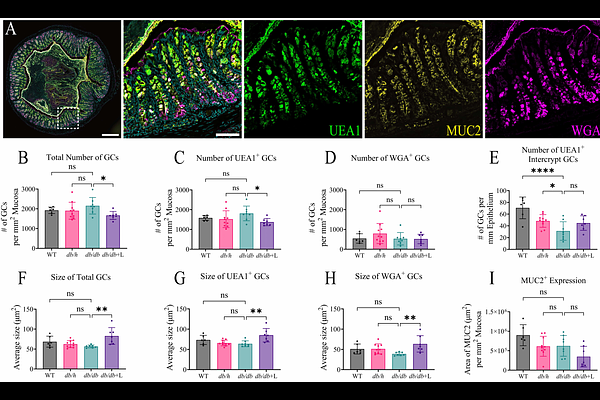
AbstractBackground & Aims: Diabetes mellitus has been associated with both intestinal barrier dysfunction and peripheral neuropathy leading to increased risk of infection. The mucus layer forms a physical barrier against pathogens and is a critical component of the intestinal barrier that may be impaired in diabetes. This study aimed to assess how diabetes impacts goblet cells (GCs), mucus layer integrity, and innervation in the colon. Methods: Fluorescence microscopy was used to investigate GCs, the mucus layer, and innervation in the colon of db/db mice. Custom open-access image analysis pipelines were developed to quantify GC numbers, location and content, mucus thickness, bacterial colonization, and innervation density in intestinal tissue sections. We also treated mice with the clinically used glucagon-like peptide 1 receptor (GLP-1R) agonist liraglutide to assess its capacity to reverse pathological changes to GCs and the mucus layer in a model of established type 2 diabetes (T2DM). Results: The mucus layer was significantly thinner in the colon of db/db mice with established diabetes and bacteria more readily colonized the epithelium and crypts. Intercrypt GC numbers were significantly reduced in db/db mice. However, there were significantly more GCs per crypt, and crypts were elongated in the db/db colon. Innervation was reduced in the mucosa and external muscle of the colon, consistent with diabetic neuropathic changes. Liraglutide treatment increased the size of GCs but had no effect on GC numbers, mucus thickness, or innervation in this model of established T2DM. Conclusions: Mucus barrier dysfunction and GC hyperplasia is evident in the db/db colon. Increased microbial penetrability through the mucus layer suggests potential implications for the increased risk of gastrointestinal infection in diabetes.