High glucose confers senescence resistance via GLUT1 epigenetic rewiring to blunt immunotherapy responses in esophageal squamous cell carcinoma

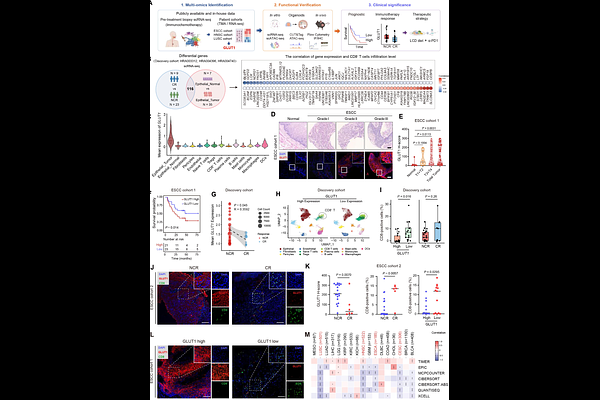
High glucose confers senescence resistance via GLUT1 epigenetic rewiring to blunt immunotherapy responses in esophageal squamous cell carcinoma
Dong, J.-X.; Zhou, J.; Hao, J.-J.; Kong, S.; Yin, C.; Wei, D.-D.; Wang, F.; Ma, J.; Fang, J.; Zhang, Y.-W.; Pan, H.; Wei, W.-Q.; Wang, M.; Ma, K.; Jiang, Y.; Jiang, Y.-Y.
AbstractTherapeutic resistance and undefined predictive biomarkers severely hinder the clinical popularization of immunotherapy in esophageal squamous cell carcinoma (ESCC). Herein, we identify the glucose transporter 1 (GLUT1) as a critical determinant of immunotherapy resistance. Elevated expression of GLUT1 correlates with poor immunotherapy response and unfavorable prognosis in ESCC patients. GLUT1 deletion or inhibition enhances CD8 T cell infiltration and cytotoxicity, and sensitizes ESCC tumors to anti-PD-1 (-PD1) therapy. Importantly, dietary glucose restriction exhibits equivalent antitumor efficacy to GLUT1 inhibition when combined with -PD1. Mechanistically, GLUT1 establishes a positive feedback loop with HAT1 and FOXM1, which epigenetically remodels chromatin accessibility to suppress tumor cell senescence, thereby impeding CD8 T cell-mediated antitumor immunity. Our findings highlight GLUT1 as a predictive biomarker of immunotherapy resistance and suggest dietary glucose restriction as a viable strategy to potentiate immunotherapy efficacy in ESCC.