Pest evolution amplifies projected crop losses under climate change

Pest evolution amplifies projected crop losses under climate change
von Schmalensee, L.; Rocabado-Penanco, C.; Cazaux, E.; Lancaster, L.; Bocedi, G.; Berger, D.
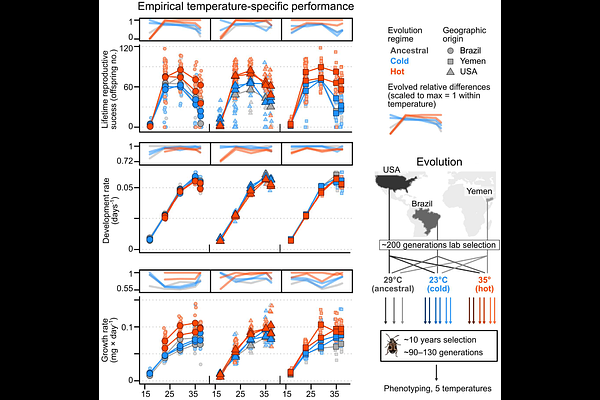
AbstractClimate change influences the physiology and population dynamics of ectothermic pests, with major repercussions for global crop production. Yet, how evolution modulates these outcomes remains unclear. We exposed the widespread beetle pest Callosobruchus maculatus to 10 years of experimental evolution at different temperatures and quantified thermal responses of life-history traits. Hot- and cold-adapted populations evolved differences in thermal sensitivity, but these were modest relative to evolved differences in trait averages. By leveraging high-resolution temperature time-series we show that the observed evolution translates into cold-adapted genotypes having highest fitness in cold climates and hot-adapted genotypes in warm climates. Hot-adapted beetles maximize fitness in warm climates by increased larval growth, resulting in larger body sizes and higher fecundity. This evolutionary strategy compounds projected crop losses under warming by increasing both intrinsic population growth and per-capita host consumption rates. By year 2100 under intermediate-to-high warming (SSP3-7.0), pest evolution is projected to increase global crop damage potential by +113% from present--twice that expected from warming alone (not accounting for evolution). In major crop-producing areas, where temperatures and the beetles' host consumption rates are already high, warming increases average crop damage potential by +29%, but evolution amplifies this three-fold to +87%. Evolution also expands C. maculatus' projected colonizable range and in some regions even flips forecasted crop damage reductions into increases. These results identify climate-driven evolution of pest life-histories as an amplifier of agricultural losses and suggest that current projections may significantly understate the threat warming poses to future food security.